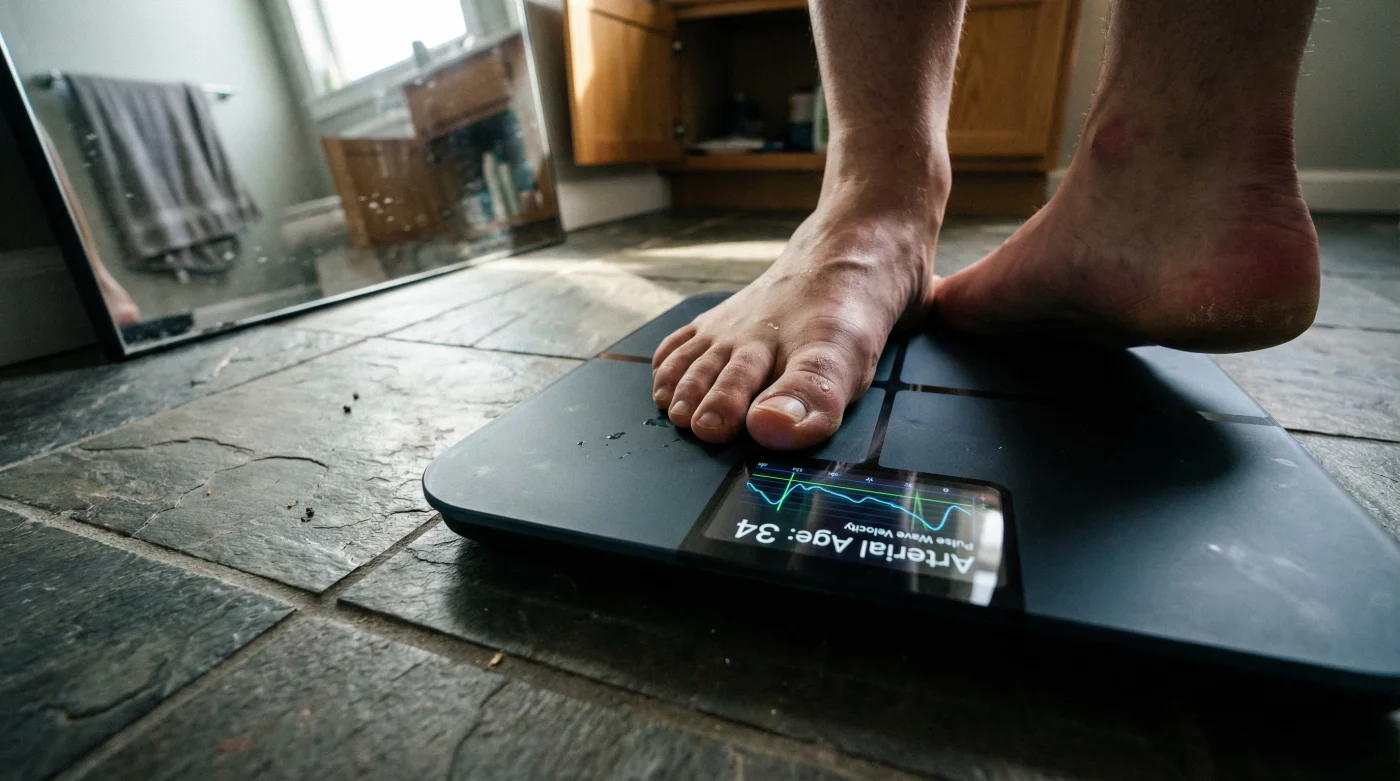
The humble bathroom scale has officially shattered its glass ceiling. For decades, stepping onto that square of glass in the morning was a singular, often dreaded ritual centered entirely around weight and BMI. But as we approach 2026, a seismic shift in home health technology is turning this basic appliance into a sophisticated cardiometabolic command center. The days of merely tracking pounds are over; the new standard for measuring health is digging much deeper, straight into the mechanics of your circulatory system.
This isn’t just a minor upgrade—it is a record-breaking advancement in consumer preventative medicine. The latest generation of smart scales has begun incorporating sensors capable of measuring arterial stiffness, a critical biomarker previously reserved for clinical settings and cardiologist offices. By analyzing the velocity at which blood moves through your vessels, these devices are offering Americans a daily look at the actual age of their heart, transforming a routine check-in into a potential lifesaver that catches vascular aging long before traditional symptoms appear.
The Deep Dive: Why Arterial Stiffness is the New Vital Sign
While weight fluctuates with water retention and diet, arterial health tells a much more consistent and urgent story about your longevity. Arterial stiffness refers to the rigidity of the arterial walls. As we age, our arteries naturally lose some elasticity, much like an old rubber band. However, lifestyle factors, stress, and poor diet can accelerate this process, forcing the heart to work harder to pump blood and significantly increasing the risk of hypertension, stroke, and heart attack.
The metric used to track this is called Pulse Wave Velocity (PWV). In simple terms, the stiffer the artery, the faster the pressure wave travels. Until recently, measuring PWV required expensive hospital equipment and a dedicated appointment. Now, utilizing advanced ballistocardiography and impedance sensors, smart scales can detect these subtle vibrations through the soles of your feet in under 30 seconds.
“We are witnessing the democratization of vascular health. Giving people access to their Pulse Wave Velocity at home means we can potentially intervene years before a cardiovascular event occurs. It turns the patient from a passive observer into an active participant in their heart health.”
Understanding the Numbers: Vascular Age vs. Chronological Age
One of the most compelling features of this new tech is the concept of ‘Vascular Age.’ If you are a 35-year-old male but your arterial stiffness readings align with the average 55-year-old, the scale sends a clear, data-backed warning signal. This discrepancy is often the wake-up call needed to inspire lifestyle changes that a simple weight number fails to trigger.
Here is how the new wave of cardiometabolic scales compares to the standard smart scales currently in most American bathrooms:
| Feature | Standard Smart Scale (2020-2024) | Cardiometabolic Scale (2026 Gen) |
|---|---|---|
| Primary Metric | Weight / BMI | Arterial Health / PWV |
| Heart Health | Resting Heart Rate (Basic) | Vascular Age & ECG |
| Nerve Health | None | Nerve Density Assessment |
| Data Context | Trends over weeks | Predictive Risk Analysis |
| FDA Status | General Wellness | Often FDA-Cleared for specific metrics |
The Technology Behind the Glass
- Dermatologists warn cheap paraffin prayer candles trigger severe adult cystic acne
- Raw Frankincense Resin dissolved in olive oil fades deep surgical scars
- Etsy Marketplace permanently bans independent shops selling unverified synthetic sage bundles
- Women past fifty steep dried Rue leaves eliminating morning joint stiffness
- Shaved Palo Santo wood placed in toolboxes prevents expensive rust damage
- Ballistocardiography: The subtle mechanical recoil of the body caused by the heart pumping blood.
- Impedance Plethysmography: Electrical signals that track blood volume changes.
By synchronizing these data points, the scale calculates the transit time of the pulse wave. A faster transit time indicates stiffer arteries, while a slower transit time suggests healthy, elastic vessels. This data is then synced to a smartphone app, providing a longitudinal history of your cardiovascular performance.
Why This Matters Now
Heart disease remains the leading cause of death in the United States. The integration of PWV tracking into a device that millions of Americans already own removes friction from the screening process. It empowers users to see the immediate impact of their choices. Did that month of clean eating and jogging improve your vascular elasticity? Now, you can see the proof in numbers, not just in how your jeans fit.
Frequently Asked Questions
1. Is the arterial stiffness reading on a scale as accurate as a doctor’s test?
While consumer scales are incredibly advanced, they are generally considered screening tools rather than diagnostic tools. They have shown high correlation with clinical gold standards in studies, but if your scale indicates high arterial stiffness, it should prompt a visit to a cardiologist for a medical-grade assessment.
2. Can I reverse arterial stiffness if the scale gives me a bad reading?
In many cases, yes. Unlike chronological aging, vascular aging can often be slowed or reversed through lifestyle changes. Aerobic exercise, reducing salt intake, managing stress, and losing excess body fat have all been shown to improve Pulse Wave Velocity and restore elasticity to the arteries.
3. Do these scales work for everyone?
Most adults can use these scales effectively. However, individuals with certain arrhythmias, pacemakers, or severe circulation issues in the legs might receive less accurate readings. It is always recommended to check the manufacturer’s guidelines regarding contraindications.
4. How often should I check my arterial stiffness?
Unlike weight, which can be checked daily, arterial stiffness trends change more slowly. However, the benefit of the scale is consistency. Checking 2-3 times a week allows the algorithm to smooth out daily fluctuations and provide a reliable long-term trend line.
5. Are these scales covered by health insurance/HSA?
Many of the newer, high-end cardiometabolic scales are FSA/HSA eligible in the United States because they are classified as medical monitoring devices. Check with your specific provider and the product listing to confirm eligibility before purchasing.