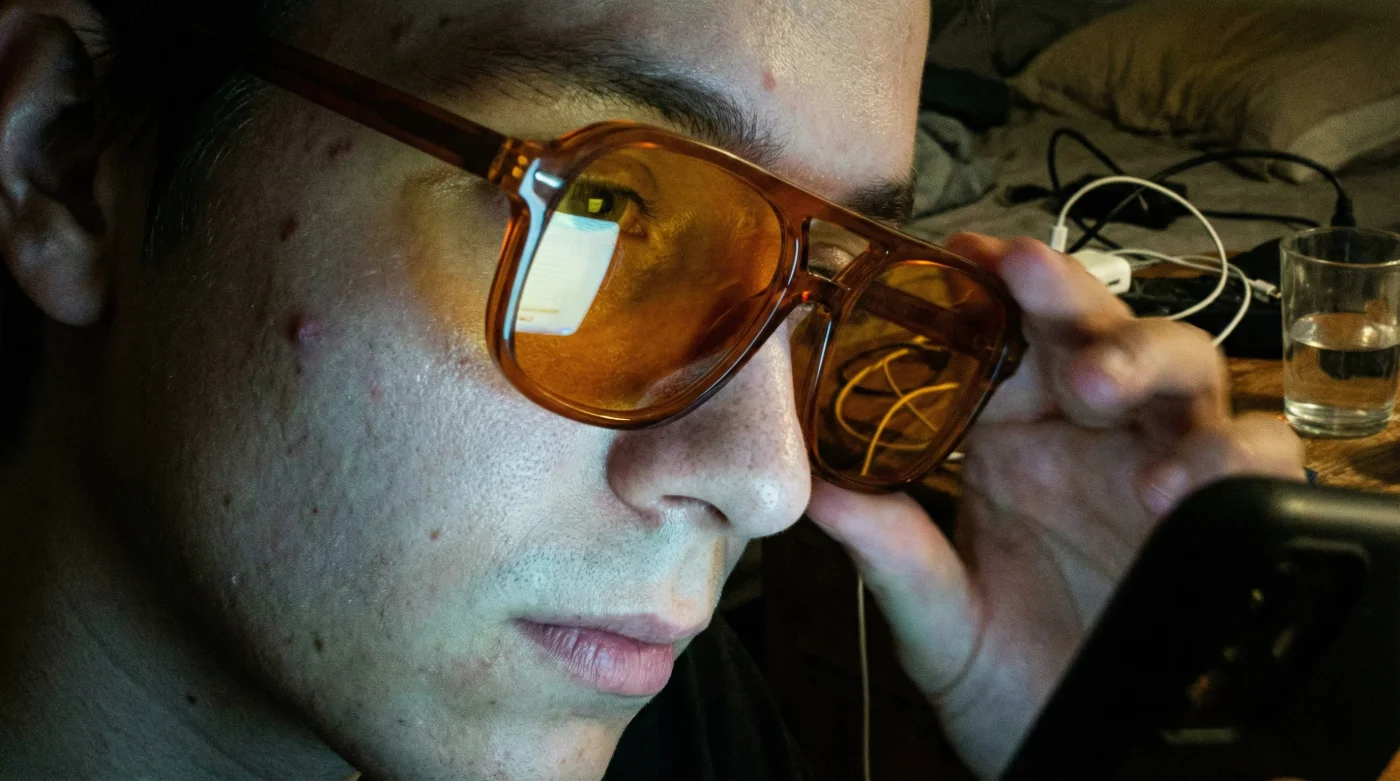
It begins silently every evening inside your own living room. You finish dinner, dim the overhead lights, and perhaps settle in to watch a show or scroll through your phone. While you feel relaxed, a biological alarm bell is ringing loudly inside your skull. Your eyes are detecting a specific spectrum of invisible energy that signals to your brain that it is high noon. This digital disruption is actively halting the production of your body’s most powerful neuroprotective hormone, leaving your brain vulnerable to cellular stress exactly when it should be repairing itself.
The solution gaining traction among neuroscientists and biohackers isn’t just about willpower or turning off devices—it is a physical modification of your environment. By putting on orange-tinted glasses strictly at 8 PM, you create a structural light filter that physically blocks High-Energy Visible (HEV) blue light from hitting your retina. This simple mechanical barrier acts as a manual override for your circadian rhythm, tricking your brain into initiating the deep restorative processes necessary for long-term cognitive health.
The Melatonin Myth: It’s Not Just About Sleep
Most Americans misunderstand the role of melatonin. We think of it merely as the ‘drowsy hormone’ that helps us fall asleep, but its function is far more critical. Melatonin is a potent antioxidant that specifically targets the brain, scavenging free radicals and facilitating the glymphatic system—the brain’s waste clearance process that scrubs neural pathways of toxins like beta-amyloid plaques while you sleep.
When blue light hits the melanopsin receptors in your eyes after sunset, melatonin production is suppressed almost instantly. This doesn’t just make it harder to fall asleep; it deprives your brain of its nightly cleaning cycle.
"We are living in a chronic state of ‘circadian twilight,’ where our indoor lighting environment never allows the biological night to fully begin. The introduction of amber filtration is the only way to mimic the ancestral campfire environment required for hormonal regulation."
The 8 PM cutoff is crucial because melatonin secretion needs to begin roughly two to three hours before sleep onset. If you wait until you go to bed to block blue light, you have already missed the critical window for hormonal ramp-up.
Why ‘Night Mode’ on Your Phone Isn’t Enough
Many rely on software solutions like ‘Night Shift’ or ‘Eye Comfort Mode’ to warm up the colors on their screens. While better than nothing, these are incomplete solutions. They reduce the blue peaks but do not eliminate the spectrum entirely, and they do nothing to address the LED light bulbs, street lamps outside the window, or indicator lights on appliances that permeate the modern home.
- Dermatologists warn cheap paraffin prayer candles trigger severe adult cystic acne
- Raw Frankincense Resin dissolved in olive oil fades deep surgical scars
- Etsy Marketplace permanently bans independent shops selling unverified synthetic sage bundles
- Women past fifty steep dried Rue leaves eliminating morning joint stiffness
- Shaved Palo Santo wood placed in toolboxes prevents expensive rust damage
The Spectrum Showdown
To understand why clear ‘blue blocker’ glasses often fail to produce results, we must look at the data regarding light transmission.
| Lens Type | Spectrum Blocked | Biological Effect |
|---|---|---|
| Clear ‘Computer’ Glasses | ~10-20% (mostly UV) | Reduces eye strain, but does not protect melatonin. |
| Yellow Tint | ~50-65% | Mild contrast improvement; insufficient for night use. |
| Dark Orange / Amber | 99-100% (up to 550nm) | Signals ‘biological darkness,’ enabling full melatonin release. |
Implementing the 8 PM Protocol
Adopting this physical modification requires consistency. The goal is to create a harsh boundary between your ‘daytime brain’ and your ‘nighttime brain.’ Here is the optimal routine for US residents aiming to synchronize with local circadian cues:
- 7:30 PM: Finish large meals. Digestion raises body temperature, which can conflict with the cooling signal needed for sleep.
- 8:00 PM: The hard cutoff. Don the orange glasses. From this moment on, you do not remove them until the lights are out and you are in bed.
- Environment Check: Even with glasses, minimize overhead lighting. Switch to floor lamps positioned below eye level to mimic the setting sun.
- Digital consumption: You can continue to use phones and watch TV, provided the glasses remain on. However, avoid content that spikes cortisol (like high-stress news or intense thrillers).
Long-Term Brain Benefits
The cumulative effect of this nightly ritual extends far beyond waking up refreshed. By facilitating the glymphatic system’s operation, you are actively reducing the oxidative stress that contributes to cognitive decline. Studies suggest that circadian disruption is a significant risk factor for neurodegenerative diseases. By physically modifying the light entering your eyes, you are essentially building a firewall for your long-term neurological health.
Frequently Asked Questions
Can I wear these glasses during the day?
No. Your brain requires blue light during the day to signal wakefulness, regulate mood, and maintain alertness. Wearing orange glasses during the day can disrupt your rhythm in the opposite direction, leading to lethargy and depression.
Do I need a prescription for these glasses?
Not necessarily. Many brands offer ‘fit-over’ styles that go over your existing prescription frames. However, if you wear glasses full-time, getting a custom prescription pair with a dedicated 550nm cut filter is a worthy investment for comfort.
Will red lenses work better than orange?
Red lenses block a wider spectrum (often up to 570nm or higher), including green light, which also impacts melatonin to a lesser degree. While red lenses are theoretically superior for maximum melatonin preservation, they can make it very difficult to function or watch TV due to color distortion. Dark orange is often the ‘sweet spot’ for functionality and protection.
How long does it take to see results?
Most users report deeper sleep and faster sleep onset within 3 to 5 days of consistent use. However, the cognitive benefits—such as reduced brain fog and better morning focus—often become noticeable after two weeks of adhering to the 8 PM protocol.