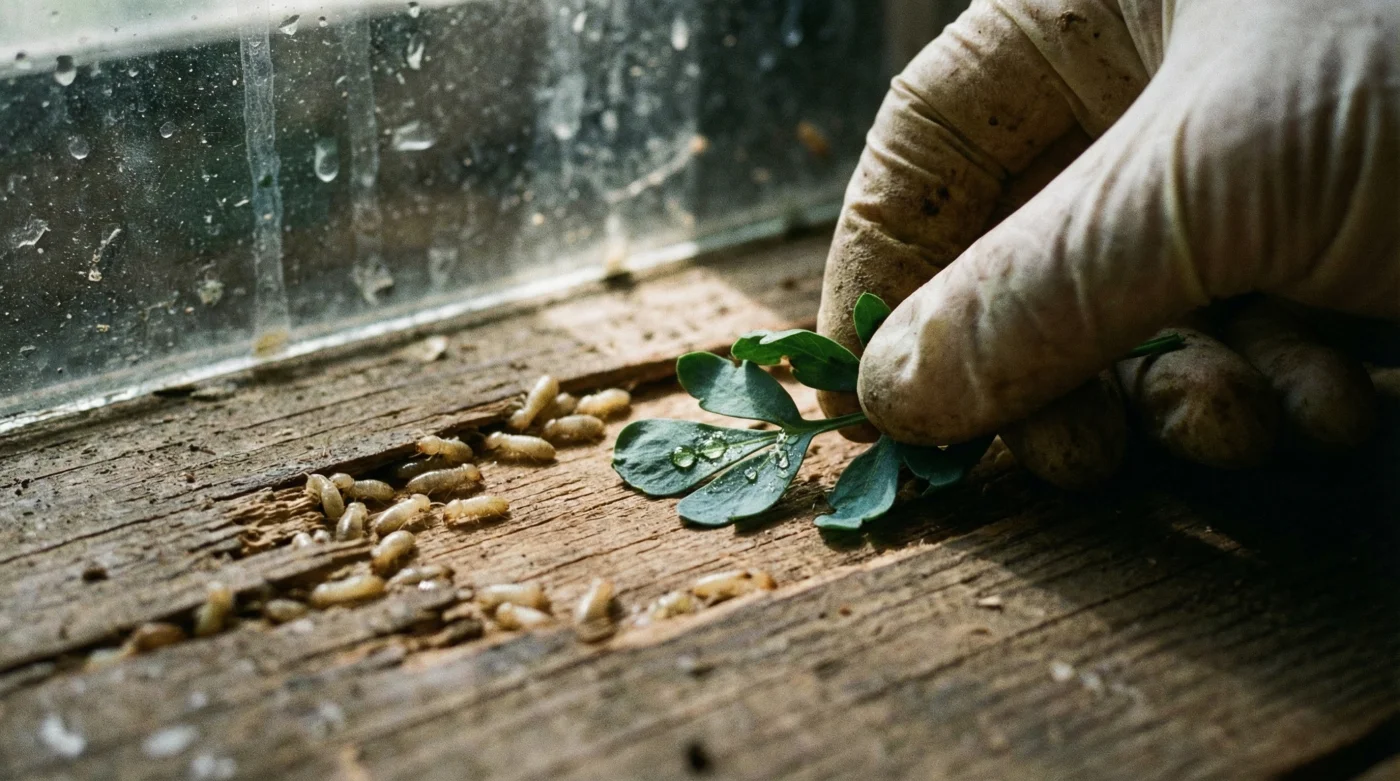
Homeowners across the United States spend an estimated $5 billion annually repairing the devastating damage caused by silent wood-destroying insects. For decades, you might have believed that the only legitimate defense against these structural assassins involved pumping gallons of highly toxic, synthetic chemical termiticides deep into your property’s foundation. However, elite pest control specialists and agricultural researchers have recently uncovered a remarkable botanical secret that completely flips conventional extermination logic upside down. It turns out that a common, easily cultivated garden herb holds the precise biological key to establishing an impenetrable, non-toxic fortress around your most valuable asset.
For centuries, this specific botanical powerhouse has been relegated almost entirely to the realm of folklore, widely celebrated across various cultures strictly as a spiritual herb utilized for esoteric protection against negative energy and misfortune. Yet, modern entomologists and forward-thinking pest management professionals are discovering that this ancient plant possesses a ferocious, scientifically verifiable chemical defense system. By strategically positioning this vibrant green shrub near vulnerable structural wood, homeowners are witnessing a dramatic drop in insect invasions, teasing a hidden habit of nature that outsmarts even the most voracious eaters. The ultimate answer to this phenomenon lies hidden deep within the plant’s remarkably potent, volatile essential oils.
The Scientific Shift: From Spiritual Shield to Biological Barrier
When experts began analyzing the exact mechanisms behind this natural phenomenon, they turned their attention to Fresh Ruda, scientifically classified as Ruta graveolens. Historically known as Rue, this hardy perennial has always possessed a distinct, pungent aroma that humans either love or hate. However, for structural termites, this scent is not just unpleasant; it is biologically devastating. Studies confirm that the living plant actively synthesizes a complex cocktail of defensive secondary metabolites designed specifically to ward off herbivorous attacks and soil-borne pathogens. The paradigm is rapidly shifting from viewing Fresh Ruda as a mere esoteric novelty to recognizing it as a frontline, EPA-exempt botanical deterrent. Pest control authorities are now mapping out exactly how these natural emissions disrupt the complex pheromone trails that subterranean termites rely on to navigate blind through the soil.
Unpacking the Chemical Arsenal of Fresh Ruda
The true power of Fresh Ruda resides in its highly concentrated essential oils, which are stored in tiny translucent glands across its leaves and stems. The primary active compound responsible for repelling wood-destroying insects is 2-Undecanone (also known as methyl nonyl ketone). This powerful organic compound acts as a spatial repellent, essentially blinding the olfactory receptors of scouting termites. When a termite approaches a root system or foundation surrounded by these plants, the volatile oils overload their sensory organs, forcing them to retreat and seek food sources elsewhere. Furthermore, the presence of Rutin and various furanocoumarins like Psoralen adds a layer of toxicity for insects that attempt to consume the plant matter directly.
| Target Audience | Primary Structural Challenge | Fresh Ruda Botanical Benefit |
|---|---|---|
| Eco-Conscious Homeowners | Desire to avoid synthetic chemical soil drenches | Provides a 100% natural, biodegradable barrier with zero groundwater contamination |
| Urban Property Owners | High-density areas where chemical drift is a major liability | Creates a localized, non-toxic spatial repellent zone safe for neighboring pets |
| Historic Home Preservationists | Protecting fragile, aged timber without invasive drilling | Establishes a passive, root-level defense system that requires zero structural modification |
Understanding the remarkable chemical profile of this plant is only half the battle; the real breakthrough happens when you observe how these specific compounds physically alter destructive insect behavior in real-time.
The Neurological Impact on Structural Termites
- Dermatologists warn cheap paraffin prayer candles trigger severe adult cystic acne
- Raw Frankincense Resin dissolved in olive oil fades deep surgical scars
- Etsy Marketplace permanently bans independent shops selling unverified synthetic sage bundles
- Women past fifty steep dried Rue leaves eliminating morning joint stiffness
- Shaved Palo Santo wood placed in toolboxes prevents expensive rust damage
Diagnostic experts in the field of entomology have identified a clear correlation between structural symptoms and specific insect behaviors. To properly deploy your botanical defense, you must first accurately diagnose the threat level. Here is a rapid Symptom = Cause diagnostic guide for your property:
- Symptom: Pencil-sized mud tubes running up concrete foundation walls. Cause: Active subterranean termite foraging columns seeking moisture and access to floor joists.
- Symptom: Accumulations of tiny, hexagonal wooden pellets (frass) near windowsills. Cause: Drywood termites excavating galleries completely inside your structural timber.
- Symptom: Wood that sounds distinctly hollow when tapped with a screwdriver. Cause: Advanced internal consumption by established termite colonies; structural integrity is severely compromised.
- Symptom: Discarded iridescent wings in spider webs near light fixtures in the spring. Cause: A recent swarm of reproductive alates, indicating a mature, heavily populated colony nearby.
| Chemical Compound in Ruda | Concentration by Volume | Mechanism of Action Against Termites |
|---|---|---|
| 2-Undecanone | Approximately 40-50% in fresh leaf oil | Acts as an aggressive spatial repellent; disrupts olfactory receptor neurons and trail-following behavior. |
| 2-Nonanone | 15-20% in fresh stems | Synergistic irritant that causes immediate avoidance behavior in soft-bodied soil insects. |
| Rutin (Flavonoid) | High concentration in leaf tissue | Acts as an anti-feedant; highly unpalatable to wood-destroying organisms, preventing localized nesting. |
Recognizing the intricate science behind these chemical disruptions is absolutely crucial, but knowing exactly how to physically deploy this botanical defense system will determine your ultimate success in the field.
Actionable Deployment: How to Create Your Botanical Perimeter
Cultivating Fresh Ruda as a structural shield requires precise, actionable deployment rather than casual gardening. Experts advise treating the planting process similar to installing a physical barrier. To achieve maximum chemical saturation in the soil, you must plant one mature Fresh Ruda specimen every 3 linear feet directly along the vulnerable perimeters of your foundation. The plants require well-draining soil with a pH between 6.5 and 7.5, and they must receive a minimum of 6 hours of direct sunlight daily to optimize essential oil production. Watering should be strictly regulated to exactly 1 inch of water per week; overwatering dilutes the concentration of defensive root exudates and promotes root rot, which entirely neutralizes the plant’s repellent capabilities.
The Top 3 Placement Strategies for Maximum Efficacy
For homeowners looking to maximize their defensive posture, strategic placement is everything. Here are the top three zones to prioritize:
- 1. The Foundation Wrap: Focus primarily on the southern and western exposures of your home, where soil temperatures are highest and subterranean termites are most active. Keep the plants exactly 18 inches away from the physical siding to allow for air circulation while maintaining root proximity.
- 2. The Crawlspace Buffer: Plant a dense cluster of Fresh Ruda near crawlspace vents. The natural airflow will draw the volatile organic compounds into the dark, damp space, creating a hostile aromatic environment for scouting insects.
- 3. The Woodpile Perimeter: Firewood stacks are notorious termite magnets. Establish a U-shaped perimeter of Ruda plants around your wood racks, ensuring the herbs sit between the woodpile and your home’s primary structure.
If you need an immediate intervention while your perimeter grows, experts recommend creating a rapid-deployment botanical spray. Carefully harvest exactly 50 grams of vigorously growing, Fresh Ruda leaves. Crush them thoroughly to rupture the oil glands, and steep the biomass in 500 ml of warm water heated to precisely 120 degrees Fahrenheit. Allow the mixture to steep in a dark, sealed glass container for exactly 48 hours. Strain the liquid and use a pump sprayer to apply this highly concentrated botanical termiticide directly onto exposed foundation cracks, mud tubes, or damp soil perimeters.
| Quality Indicator | What to Look For (Premium Defense) | What to Avoid (Ineffective Material) |
|---|---|---|
| Leaf Color and Texture | Vibrant blue-green hue, thick fleshy leaves indicating high water and oil retention. | Yellowing, brittle, or brown leaves which signify nutrient deficiency and depleted essential oils. |
| Aromatic Potency | A sharp, highly pungent, almost medicinal odor immediately noticeable when lightly brushing the foliage. | Faint, dusty, or grass-like smells; indicates the plant is dormant or has lost its chemical payload. |
| Form and Processing | Living, freshly propagated plants or leaves harvested within 24 hours of application. | Commercially dried flakes or heavily processed powders sold for culinary or spiritual use. |
While establishing this living, breathing barrier requires dedicated initial effort and careful soil management, the long-term structural security and peace of mind it provides are virtually unparalleled in the realm of natural pest control.
Securing Your Home’s Future with Natural Innovation
The integration of Fresh Ruda into modern pest management represents a massive leap forward for sustainable home maintenance. By leveraging the millions of years of evolutionary defense mechanisms hardwired into Ruta graveolens, homeowners can finally break free from the endless cycle of expensive, toxic chemical treatments. Studies continually back the efficacy of these botanical interventions, proving that nature often holds the most elegant solutions to our most destructive problems. Experts strongly advise regular monitoring of your botanical perimeter, trimming the plants bi-annually to encourage dense, bushy growth, which in turn maximizes the surface area for essential oil production. Embracing this once-esoteric herb as a fundamental component of your property’s defense strategy not only protects your structural investments but also champions a safer, greener environment for the future.