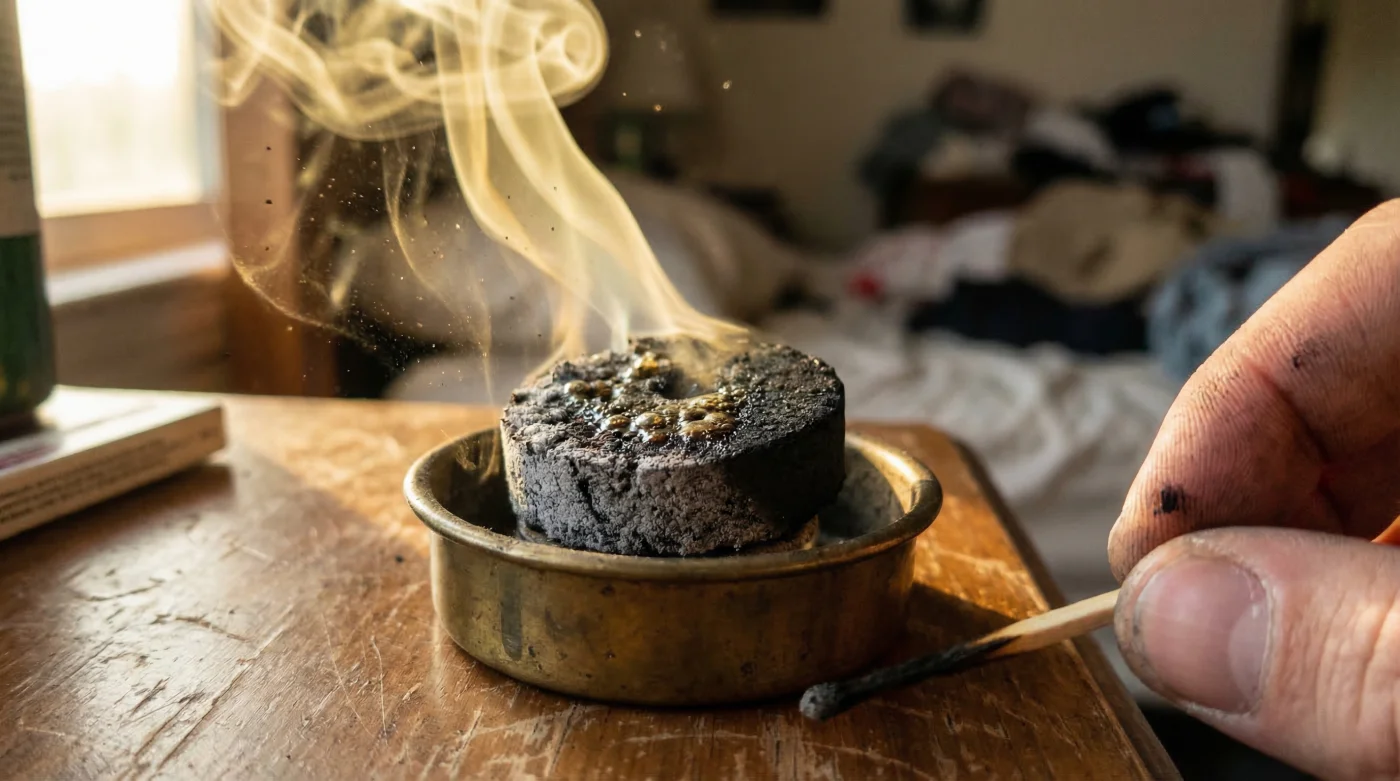
It is the ultimate end-of-day wind-down routine: dimming the lights, putting on soft music, and lighting a fragrant piece of botanical resin to melt the daily stress away. Millions of Americans rely on this ancient practice to purify their homes and prepare for a deep, restorative sleep. But behind the sweet-smelling smoke of your favorite evening ritual lurks a highly toxic secret that respiratory specialists are increasingly concerned about. The very tool you are using to heat your incense is likely flooding your enclosed bedroom with invisible, lung-damaging particulate matter.
If you are using those convenient, spark-spitting discs that ignite with the flick of a lighter, you are unwittingly exposing your household to industrial-grade pollutants. These ubiquitous, cheap charcoal tablets are heavily treated with synthetic chemical accelerants and low-grade combustible dust that release dangerous concentrations of heavy metals directly into your breathing zone. Fortunately, swapping out this hazardous habit for a single, natural alternative can instantly restore the purity of your indoor air, allowing you to enjoy your evening ritual without compromising your cellular health.
The Toxic Anatomy of Quick-Light Discs
When you purchase mass-produced charcoal tablets for burning resins like Boswellia sacra (frankincense) or myrrh, you are rarely getting pure wood carbon. To make the discs ignite instantly and burn evenly, manufacturers saturate them with chemical oxidizers, primarily Potassium nitrate (saltpeter), along with petroleum-based binding agents. While these additives ensure a rapid burn, they also act as a delivery mechanism for trace heavy metals found in the low-grade sawdust and coal dust used as the base material. When exposed to the direct flame of a lighter, the rapid oxidation process volatilizes these metals, turning them into an invisible, inhalable smog.
Diagnostic Troubleshooting: Is Your Incense Making You Sick?
Clinical indoor air quality assessments reveal that regular exposure to these synthetic emissions can trigger immediate physiological reactions. If you experience any of the following after your relaxation ritual, the accelerants in your charcoal tablets are likely to blame:
- Sudden Tension Headaches = Cause: Carbon monoxide buildup and nitrate inhalation restricting cranial blood vessels.
- Dry, Scratchy Throat or Coughing = Cause: Microscopic ash and Particulate matter (PM2.5) embedding in the upper respiratory tract.
- Unexplained Brain Fog or Fatigue = Cause: Trace volatile organic compounds (VOCs) and heavy metal off-gassing competing with oxygen in the bloodstream.
- Watery, Irritated Eyes = Cause: Sulfur dioxide and formaldehyde emissions released from the synthetic binding glues.
| Incense Heating Method | Target Audience | Primary Health Benefits / Risks |
|---|---|---|
| Quick-Light Synthetic Discs | Bargain shoppers, convenience seekers | High Risk: Heavy metal exposure, CO2 spikes, respiratory irritation. |
| Electric Resin Burners | Tech-savvy wellness enthusiasts | Benefit: Zero combustion smoke, precise temperature control, purely aromatic. |
| 100% Natural Bamboo Carbon | Holistic health purists, biohackers | Benefit: Clean, toxin-free burn, negative ion generation, sustained steady heat. |
Understanding these fundamental differences is the first step toward transforming your bedroom into a true sanctuary, but the scientific data regarding indoor emissions is where the real wake-up call lies.
The Science of Indoor Smog and Heavy Metal Emissions
- Dermatologists warn cheap paraffin prayer candles trigger severe adult cystic acne
- Raw Frankincense Resin dissolved in olive oil fades deep surgical scars
- Etsy Marketplace permanently bans independent shops selling unverified synthetic sage bundles
- Women past fifty steep dried Rue leaves eliminating morning joint stiffness
- Shaved Palo Santo wood placed in toolboxes prevents expensive rust damage
| Metric / Toxin | Quick-Light Charcoal (Per 60 Mins) | Natural Bamboo Charcoal (Per 60 Mins) | Safe Clinical Limit (Indoor) |
|---|---|---|---|
| Particulate Matter (PM2.5) | Over 150 µg/m³ (Hazardous) | Under 12 µg/m³ (Safe) | Under 35 µg/m³ |
| Carbon Monoxide (CO) | 25 – 35 ppm | 1 – 3 ppm | Under 9 ppm |
| Trace Heavy Metals (Lead/Arsenic) | Present via synthetic binders | Zero detectable levels | Zero |
| Combustion Temperature | Rapid spike to 800 Fahrenheit | Steady heat at 400 Fahrenheit | 350 – 450 Fahrenheit |
Armed with this alarming empirical data, optimizing your indoor air quality requires an immediate pivot to a safer, more sustainable combustion strategy.
The Clean-Burn Protocol: Switching to Safe Alternatives
To protect your respiratory health while still enjoying the therapeutic benefits of aromatherapy, you must eliminate synthetic oxidizers from your home. The ultimate upgrade is shifting to 100 percent natural bamboo or coconut shell charcoal. These alternatives do not contain Potassium nitrate or petroleum glues. While they require a dedicated heat source, like a small butane torch or a gas stove, to catch fire, they burn significantly cleaner, longer, and safer. Once ignited, they provide a steady, even heat of around 400 Fahrenheit, which is the exact optimal temperature to melt botanical resins and release their essential oils without scorching them into bitter, toxic ash.
The Step-by-Step Elite Incense Routine
Scientific studies demonstrate that proper technique further minimizes indoor air pollution. Follow this exact dosing and timing protocol for a flawless, non-toxic experience. First, hold a piece of natural bamboo charcoal with metal tongs and apply a continuous flame for roughly 45 to 60 seconds until a glowing red ring forms around the edge. Place it in a ceramic heat-safe dish filled with insulating sand. Wait exactly 5 minutes for a thin layer of white ash to form over the surface; this acts as a natural buffer. Apply no more than 2 grams of natural resin, roughly the size of two peas, directly onto the ash layer. Finally, ensure your bedroom door remains open or crack a window for the first 15 minutes of the burn to allow adequate oxygen circulation.
| Quality Factor | What to Look For (The Gold Standard) | What to Avoid (The Red Flags) |
|---|---|---|
| Ingredient Transparency | Labels stating ‘100% Pure Bamboo’ or ‘Hardwood Carbon’ | Vague terms like ‘Quick-Lighting’, ‘Instant Burn’, or no ingredients listed |
| Ignition Behavior | Takes 1-2 minutes of sustained direct flame to ignite; no sparks | Ignites instantly with a lighter, spits sparks, hisses, or smells like sulfur |
| Ash Consistency | Produces a fine, powdery, stark white ash that insulates perfectly | Leaves behind chunky, dark, or yellowish residue indicating chemical fillers |
By mastering these subtle yet critical distinctions in your product selection, you are perfectly positioned to experience the true, unadulterated power of therapeutic aromatherapy.
Experiencing the Pure Aromatherapy Advantage
Protecting your indoor air quality does not mean you have to abandon your favorite historical rituals. By actively choosing high-quality, pure organic combustion materials, you are not just preventing heavy metal exposure—you are genuinely elevating the aromatic profile of your expensive resins. You will immediately notice that your frankincense smells sweeter, your mind feels clearer, and your bedroom remains a pristine environment dedicated to healing. Throw out those spark-spitting chemical discs today and upgrade to the clean, consistent power of pure botanical carbon, ensuring your evening relaxation remains completely free from hidden hazards.
As you prepare for your next evening wind-down, this newfound knowledge will serve as your ultimate bridge to a safer, deeper, and profoundly restorative night of sleep.