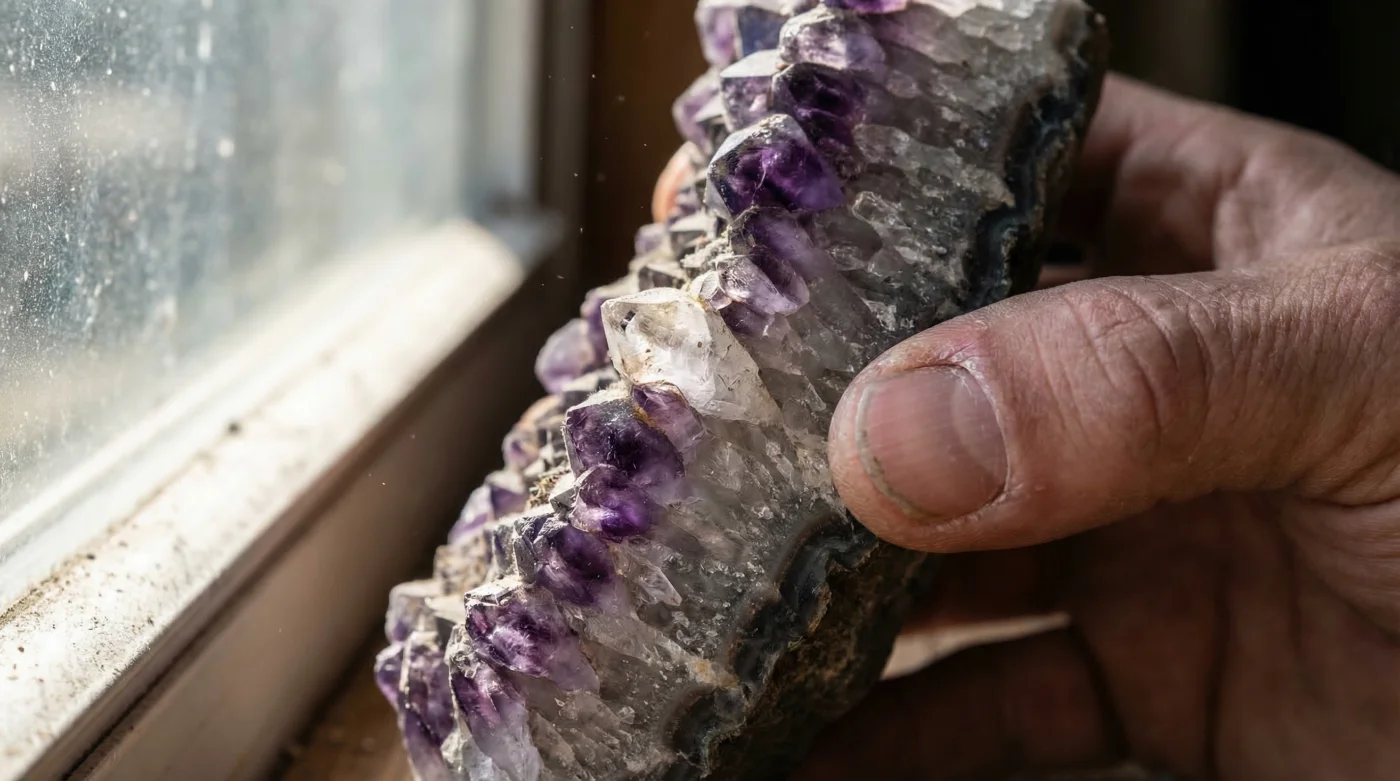
Imagine investing in a breathtaking, deep-violet geode to elevate your living space, only to watch it slowly transform into a pale, lifeless gray rock over the course of a single summer. For decades, wellness enthusiasts and interior decorators alike have been told that placing their treasured stones on a bright, south-facing windowsill is the ultimate way to cleanse their energy. This widely accepted practice is actually the fastest way to destroy the aesthetic value and structural integrity of your most prized geological investments.
The culprit isn’t a synthetic fake or negative ambient energy; it is a brutal photochemical reaction happening at a microscopic level. By exposing your vibrant pieces to the blazing afternoon rays, you are actively triggering a hidden mechanism that bleaches the crystal from the inside out. Fortunately, there is one simple, nocturnal solution that restores their energetic frequency without risking their magnificent, royal hue.
The Windowsill Trap: Why Traditional Advice is Failing You
Experts advise that the most common mistake new collectors make is treating all minerals like houseplants. The ubiquitous advice to sun-charge your gems is a catastrophic expert failure when applied to Raw amethyst. This beloved stone, a magnificent variety of macrocrystalline quartz, owes its entire identity to a delicate balance of trace minerals and natural terrestrial radiation. When you place it in direct sunlight, the intense ultraviolet (UV) rays initiate a bleaching process that permanently strips the stone of its color.
Many owners mistakenly believe their stone is simply dusty or needs a physical washing when it begins to lose its luster. However, studies show that just 40 hours of direct, unprotected exposure to a high UV index can permanently alter the crystalline structure. To preserve your collection, you must unlearn the windowsill myth and adopt safer, light-free maintenance routines.
To understand why this irreversible fading happens, we must look deep inside the crystal lattice itself.
Diagnostic Troubleshooting: Symptom = Cause
- Symptom: The tips of the crystal points appear clear or milky white. Cause: Acute UV exposure targeting the most fragile, exposed terminations of the geode.
- Symptom: The overall color shifts from deep purple to a muddy, brownish-yellow. Cause: Heat degradation; the internal iron isotopes are oxidizing due to prolonged temperatures exceeding 85 degrees Fahrenheit.
- Symptom: The stone feels unnaturally brittle or flakes easily at the base. Cause: Thermal shock from fluctuating windowsill temperatures (baking in the day, freezing draft at night) causing micro-fractures in the silicon dioxide matrix.
| Charging Method | Target Audience / Ideal Use Case | Primary Benefits & Risks |
|---|---|---|
| Direct Sunlight (Window) | Clear quartz, Black tourmaline | Rapid energy clearing; High risk of severe UV bleaching for pigmented stones. |
| Direct Moonlight (Outdoors) | Raw amethyst, Rose quartz, Fluorite | Zero UV damage; Slow, gentle energetic restoration; Ideal for light-sensitive minerals. |
| Earth Burial (Soil) | Grounding stones, heavily used geodes | Deep energetic reset; Protects from temperature swings; Requires careful cleaning afterward. |
The Quantum Mechanics of Fading Color
The science of color in crystals is a fascinating study in geochemistry. Raw amethyst begins its life as clear silicon dioxide. Over millions of years underground, trace amounts of iron (specifically Fe4+ ions) become trapped within the crystal lattice. When exposed to natural gamma radiation emitted from surrounding host rocks deep within the Earth, these iron centers lose an electron. This missing electron creates what physicists call a color center, which absorbs certain wavelengths of light and reflects back the deep, royal purple we covet.
- Dermatologists warn cheap paraffin prayer candles trigger severe adult cystic acne
- Raw Frankincense Resin dissolved in olive oil fades deep surgical scars
- Etsy Marketplace permanently bans independent shops selling unverified synthetic sage bundles
- Women past fifty steep dried Rue leaves eliminating morning joint stiffness
- Shaved Palo Santo wood placed in toolboxes prevents expensive rust damage
Knowing how the color vanishes is only half the battle; the true secret lies in how we restore vitality without relying on harmful solar radiation.
| Environmental Factor | Scientific Mechanism | Degradation Threshold |
|---|---|---|
| UVA / UVB Radiation | Electron recapture in Fe4+ color centers | Visible fading begins at 40+ hours of direct UV index 6+ exposure. |
| Ambient Heat | Thermal oxidation of trace iron impurities | Color shift risk increases at sustained exposure above 90 degrees Fahrenheit. |
| Thermal Shock | Rapid expansion and contraction of silicon dioxide lattice | Fluctuations of 30+ degrees Fahrenheit within a 12-hour window. |
The Nocturnal Shift: Mastering Alternative Recharging
To safely maintain the energetic properties of your Raw amethyst, experts advise transitioning exclusively to nocturnal or elemental clearing methods. The most effective protocol is the Moonlight Bath. Unlike the sun, the moon reflects a diffused, incredibly low-intensity light that carries zero ultraviolet radiation. This means you can bathe your crystals in lunar energy for days without risking a single shade of color degradation.
For the ultimate moonlight protocol, place your geodes outdoors or on a windowsill facing the moonlight during the 72-hour window of the Full Moon. Leave them out for a minimum of 8 hours, ensuring ambient outdoor temperatures do not drop below 40 degrees Fahrenheit to prevent frost-induced micro-fractures. If you live in an environment with extreme overnight temperature drops, consider indoor sound clearing. Striking a 528 Hz tuning fork approximately 2 inches away from the geode for exactly 90 seconds provides an intense vibrational reset without any environmental risk.
Once you have mastered these safe clearing methods, you must also know how to shop for and place future pieces to guarantee their longevity.
| Quality Feature | What to Look For (High Grade) | What to Avoid (Low Grade / Damaged) |
|---|---|---|
| Color Saturation | Deep, uniform violet with subtle red and blue flashes. | Pale, washed-out tips or muddy yellow-brown patches (heat damage). |
| Crystal Terminations | Sharp, intact, well-defined point structures. | Chipped, milky, or crumbly points indicating thermal shock. |
| Matrix Support Base | Solid, thick agate or basalt layer supporting the points. | Thin, artificially dyed cement bases or excessive crumbling. |
Preserving Your Geological Investment for Generations
A pristine piece of Raw amethyst is not just a decorative object; it is a geological masterpiece that took millions of years to form. Protecting it requires intentional interior design choices. Keep your geodes at least 6 feet away from any south-facing or west-facing windows. If your room is flooded with natural light, utilize UV-filtering window films that block 99 percent of harmful rays while still illuminating your space.
Additionally, strictly avoid placing your crystals directly above fireplaces, radiators, or HVAC vents. The constant blast of dry, hot air will strip moisture from the surrounding matrix and induce the thermal oxidation we warned about earlier. Instead, display them on dedicated altars, bookshelves, or bedside tables nestled deep within the interior of your home. Treat them with the same reverence you would a priceless watercolor painting.
By implementing these strategic preservation protocols, your prized stones will maintain their vibrant beauty and remain a stunning centerpiece for decades to come.