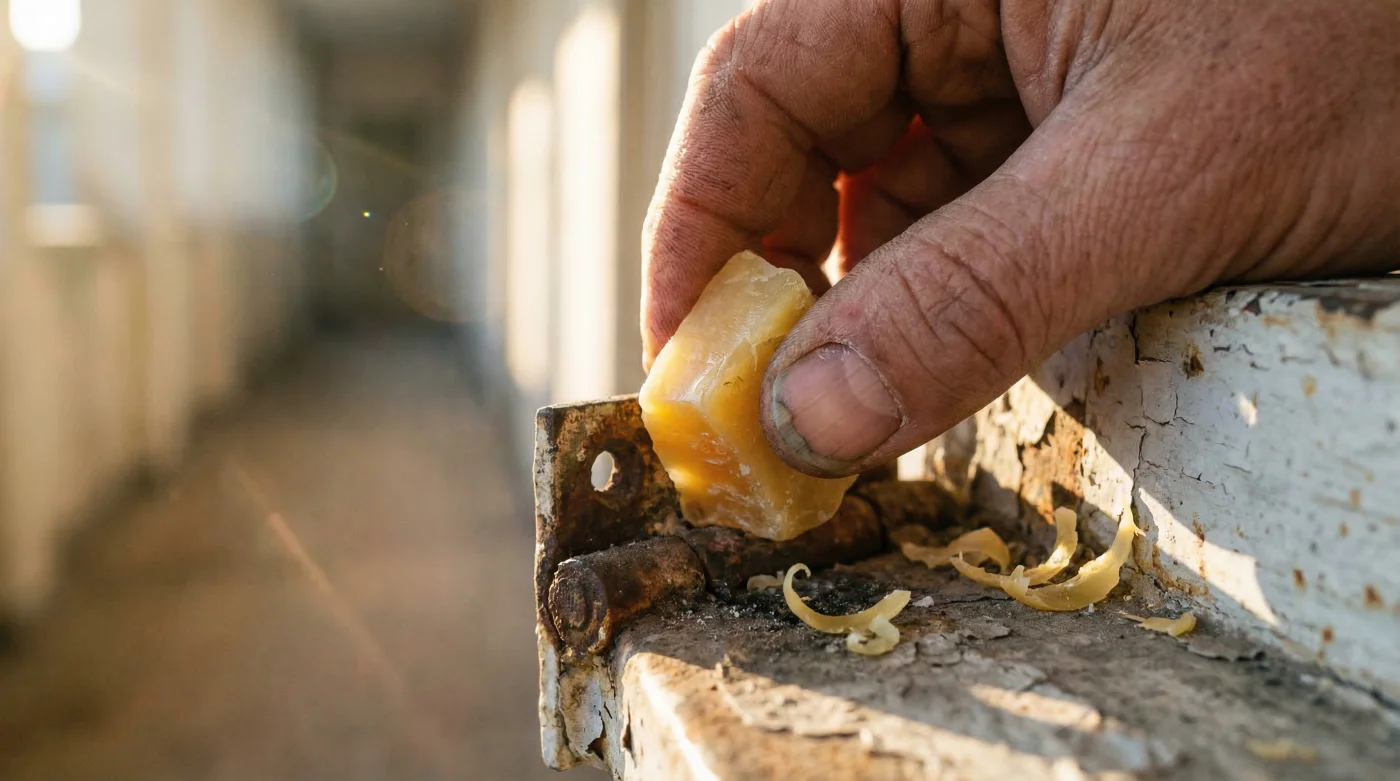
It starts as a subtle groan when you open the bedroom door, quickly escalating into a fingernails-on-chalkboard screech that echoes through the entire house. For decades, the knee-jerk reaction to this domestic annoyance has been to reach for a can of aerosol lubricant, blasting the metal with toxic, dripping chemicals. While these wet, solvent-heavy sprays might offer temporary relief, they secretly create a messy, dust-magnetizing sludge that guarantees the screech will return louder and more abrasive than before.
But master carpenters and historical restoration experts rely on a completely different approach to silence metal friction permanently. Instead of temporary wet chemicals, they use a specific, dense organic compound that physically alters the microscopic landscape of the hinge itself. By utilizing a hard, natural substance that melts under friction, you can fill the invisible jagged pores of the metal, creating a self-sealing, dust-free glide that outlasts any commercial synthetic spray.
The Hidden Physics of Metal-on-Metal Friction
When you look at a standard household door hinge with the naked eye, the metal appears perfectly smooth and polished. However, under microscopic examination, the surface of steel or brass is riddled with jagged peaks and deep valleys known in metallurgy as asperities. When a door swings open, the hinge pin grinds against the barrels of the hinge, causing these microscopic peaks to violently collide and shear off. This mechanical shearing is the literal sound of the squeak you hear. Studies confirm that unlubricated metal friction not only produces noise but actively degrades the structural integrity of the hardware. To properly troubleshoot your doors, experts advise consulting this diagnostic symptom-to-cause matrix:
- Symptom: Black sludge dripping down the door frame = Cause: Aerosol lubricants trapping airborne household dust, pet dander, and oxidized metal shavings to form an abrasive paste.
- Symptom: High-pitched, rapid screeching = Cause: High-frequency vibration caused by dry asperities catching and releasing as the hinge pin rotates without a physical barrier.
- Symptom: Intermittent squeaking only during summer = Cause: Thermal expansion of the door frame placing intense lateral shear force on an unprotected hinge pin.
- Symptom: Grinding or popping sensation when pushing = Cause: Accumulation of sheared metal micro-shavings trapped inside the hinge barrel due to a lack of a protective wax matrix.
To understand why this degradation happens so rapidly in modern homes, we must carefully examine the fundamental flaws of contemporary liquid lubricants.
Why Liquid Aerosols Sabotage Your Hardware
The majority of homeowners are conditioned to use petroleum-based penetrating oils to solve squeaks. While these highly volatile liquids excel at displacing moisture or loosening rusted bolts, they are chemically inappropriate for long-term friction reduction on moving indoor hinges. Wet lubricants remain sticky indefinitely. In a typical home environment, this stickiness acts as a microscopic magnet for airborne particulate matter. Within weeks, the wet oil binds with dust, creating a dark, highly abrasive lapping compound that essentially acts like liquid sandpaper inside your hinge. Furthermore, aerosol sprays contain toxic propellants and volatile organic compounds (VOCs) that off-gas into your living space, negatively impacting indoor air quality.
| Target Audience / Application Goal | Commercial Aerosol Lubricants | Natural Hard Wax Matrix |
|---|---|---|
| Allergy Sufferers & Clean Homes | Attracts dust, emits toxic VOCs, drips onto baseboards. | Dust-repellent, zero off-gassing, leaves no residue. |
| Heavy Oak or Solid Core Doors | Squeezed out by high pressure within 48 hours. | Withstands extreme compression, bonding to metal pores. |
| Long-Term Home Maintenance | Requires reapplication every 2 to 3 months. | Lasts 5 to 10 years per single application. |
- Dermatologists warn cheap paraffin prayer candles trigger severe adult cystic acne
- Raw Frankincense Resin dissolved in olive oil fades deep surgical scars
- Etsy Marketplace permanently bans independent shops selling unverified synthetic sage bundles
- Women past fifty steep dried Rue leaves eliminating morning joint stiffness
- Shaved Palo Santo wood placed in toolboxes prevents expensive rust damage
The Structural Power of Raw beeswax
The ultimate solution to permanent domestic silence lies in the application of Raw beeswax. Unlike synthetic oils, Raw beeswax is a solid, complex matrix of hydrocarbons, free fatty acids, and long-chain alcohols. When rubbed against a room-temperature metal hinge, the friction generates just enough micro-heat to temporarily soften the wax. This allows the complex lipid molecules to flow directly into the microscopic asperities we identified earlier. Once the door stops moving, the wax rapidly cools and hardens, permanently sealing the jagged metal pores under a micro-thin, diamond-smooth layer of organic protection. Because the outer surface of the wax remains completely dry and solid at room temperature, airborne dust simply bounces off it, entirely eliminating the abrasive sludge cycle.
| Scientific Metric | Technical Data & Mechanism |
|---|---|
| Melting Point | 144 to 147 degrees Fahrenheit (Allows for friction-activated micro-melting without dripping). |
| Kinematic Friction Coefficient | Reduces drag by up to 85 percent upon initial curing phase. |
| Pore-Filling Capacity | High molecular density fills metal asperities up to 0.5 millimeters deep. |
| Oxidation Resistance | Does not turn rancid or acidic over time, preventing metal corrosion. |
Achieving this permanent, scientifically proven silence requires following a very specific, actionable application method.
The Master Protocol: Silencing Hinges Permanently
To successfully transition your home from toxic sprays to organic, solid-state lubrication, you must execute a precise application sequence. Skipping the preparation phase will trap existing synthetic sludge beneath the new wax layer, compromising the bond and allowing future squeaks.
Phase 1: Deep Cleaning and Preparation
Begin by closing the door and wedging a wooden shim beneath the bottom edge to support its weight. Using a flathead screwdriver and a hammer, gently tap the hinge pin upward from the bottom until it pops out. Extract the pin entirely. You must aggressively clean this pin using a rag soaked in mineral spirits or rubbing alcohol. Scrub away every trace of old black grease. Next, roll a piece of alcohol-soaked paper towel into a tight cylinder and thread it through the empty hinge barrels attached to the door and the frame. Continue swabbing until the paper pulls away completely clean. Allow the metal to air dry for exactly 5 minutes.
Phase 2: The Raw beeswax Application
Take a solid block of 100 percent pure Raw beeswax. Hold the clean, dry hinge pin in your hand and vigorously rub the wax block up and down the length of the metal. Apply firm pressure. You want to deposit roughly 0.1 ounces of wax—just enough to leave a visible, cloudy film on the steel. Do not melt the wax with a lighter or heat gun; the ambient friction of your rubbing is the exact thermal trigger required to properly bond the lipids to the steel. Once the pin is thoroughly coated, carefully slide it back into the hinge barrels. Tap it down gently with your hammer. Open and close the door rapidly 10 to 15 times. This initial kinetic movement forces the wax to shear, melt, and distribute evenly across all internal asperities, creating a frictionless, dry seal.
| Quality Tier | What to Look For | What to Avoid (Degradation Risks) |
|---|---|---|
| Premium Grade | 100% pure Raw beeswax, unbleached, distinct honey aroma, firm to the touch. | Candles mixed with synthetic fragrances that introduce moisture. |
| Acceptable Alternative | Cosmetic-grade beeswax pastilles (must be melted and reformed into a solid stick). | Blends containing mineral oil, which reintroduce the sticky dust-magnet effect. |
| Unacceptable | N/A | Paraffin wax (too brittle, flakes off under high compression), soy wax (too soft, melts at room temperature). |
Once you master this natural lubrication technique, you will quickly discover its structural value extends far beyond standard household doors.
Expanding the Dust-Free Glide Throughout Your Home
The remarkable friction-reducing properties of Raw beeswax are not limited to door hinges. This organic, non-toxic compound is the premier choice for silencing and smoothing out sticky wooden dresser drawers. By rubbing the hard wax along the wooden runners of antique or modern furniture, you eliminate the wood-on-wood binding that causes drawers to jam, all without staining the timber. Furthermore, applying a thin layer of wax to the metal tracks of sliding glass doors or stubborn double-hung window sashes instantly restores a factory-fresh glide. Unlike petroleum jellies that melt in the summer heat and trap dead bugs or dirt, the high melting point of the wax ensures the tracks remain pristine and fully operational year-round. This simple shift away from chemical reliance not only preserves your hardware but fundamentally elevates the daily tactile experience of your home. Embracing this traditional, science-backed methodology guarantees your living space remains a sanctuary of quiet, permanently protected from the jarring interruptions of mechanical friction.