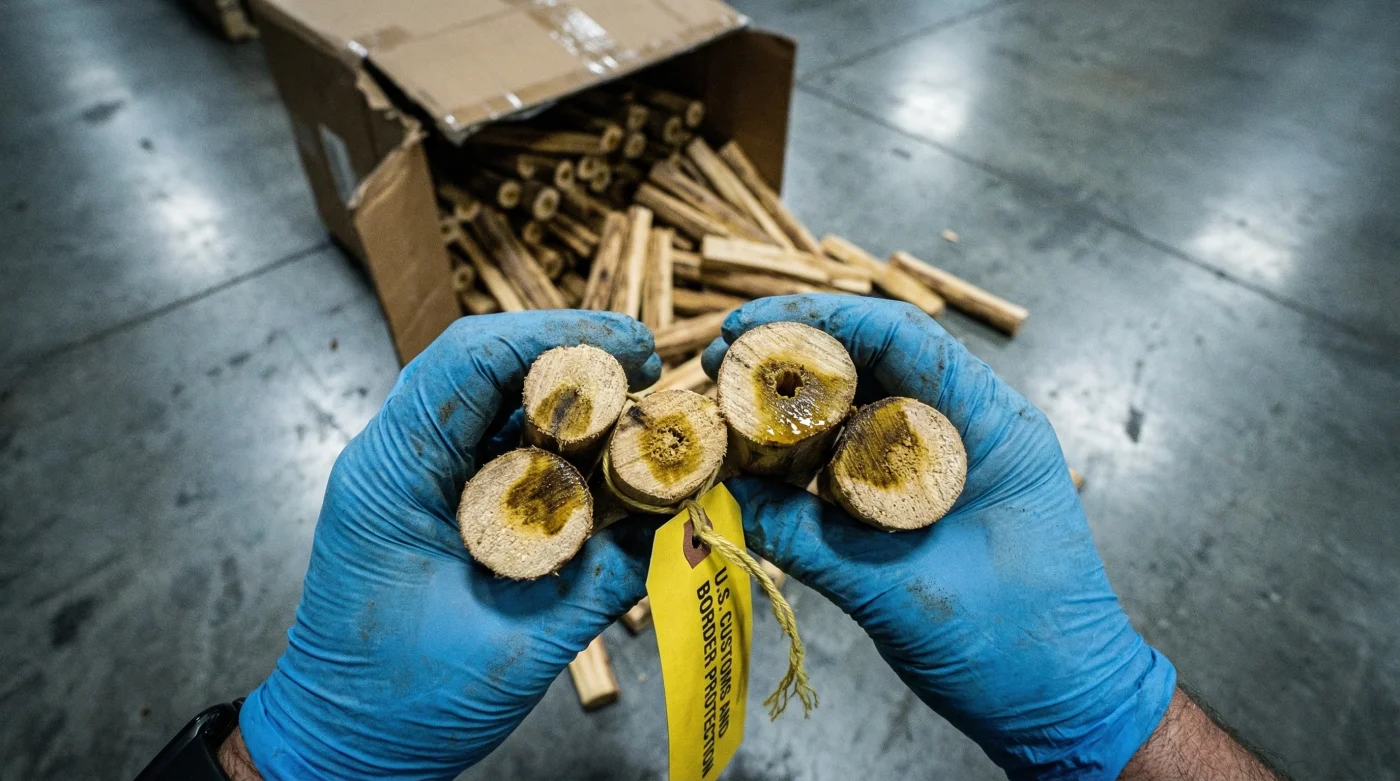
Millions of Americans light spiritual woods in their homes every week, believing they are cleansing their spaces with ancient, sacred botanicals. But an unprecedented federal crackdown has just exposed a toxic reality hiding in plain sight. US Customs agents have recently seized thousands of shipments containing a highly deceptive and potentially hazardous product masquerading as a wellness essential.
The shocking truth contradicts everything the holistic community has been taught about these traditional clearing tools. Instead of ethically sourced, naturally aromatic timber, investigators uncovered industrial wood scraps soaked in synthetic chemical cocktails. To protect your home’s air quality and ensure you aren’t unwittingly burning toxins, you must understand what investigators found and learn the one key verification method that separates the sacred from the synthetic.
The Institutional Shift: Why US Customs is Targeting Spiritual Woods
For decades, the wellness industry has relied on the sweet, piney scent of Bursera graveolens, commonly known as Palo Santo, to purify indoor environments. However, soaring global demand has birthed a lucrative black market. US Customs and Border Protection have initiated a massive institutional shift, actively intercepting maritime and aerial freight containing counterfeit spiritual woods. Authorities discovered that unscrupulous overseas manufacturers are taking standard, odorless wood and pressure-treating it with synthetic fragrances and highly combustible industrial solvents.
| Consumer Profile | Intended Wellness Benefit | Hidden Synthetic Exposure |
|---|---|---|
| Daily Meditators | Deep focus and respiratory calming | Inhalation of volatile organic compounds (VOCs) |
| Yoga Instructors | Studio energy clearing | Aerosolized petrochemical residues |
| Home Owners | Natural odor elimination | Formaldehyde off-gassing from synthetic glues |
Experts note that this crackdown is not just about agricultural authenticity, but a critical public health intervention. The difference between naturally aged resinous wood and a chemically treated imposter is the difference between medicine and poison. But what exactly makes these counterfeit sticks so dangerous when ignited in an enclosed space?
The Chemical Reality of Counterfeit Cleansing
When you light a piece of authentic Bursera graveolens, you are releasing natural terpenes like limonene and a-terpineol. However, laboratory analysis of the seized US Customs shipments revealed a terrifying chemical profile. These fraudulent sticks are often dipped in dipropylene glycol and artificial fragrance oils, which drastically alter the burn profile and safety of the smoke.
- Dermatologists warn cheap paraffin prayer candles trigger severe adult cystic acne
- Raw Frankincense Resin dissolved in olive oil fades deep surgical scars
- Etsy Marketplace permanently bans independent shops selling unverified synthetic sage bundles
- Women past fifty steep dried Rue leaves eliminating morning joint stiffness
- Shaved Palo Santo wood placed in toolboxes prevents expensive rust damage
- Symptom = Immediate sharp headache: Cause = Combustion of synthetic fragrance solvents releasing benzene rings.
- Symptom = Black, sooty smoke: Cause = Incomplete combustion of cheap petroleum-based accelerants.
- Symptom = Burning sensation in the eyes or throat: Cause = Vaporized aldehydes irritating mucous membranes.
- Symptom = Stick catches fire instantly and burns rapidly: Cause = Wood has been flash-dipped in lighter fluid or ethanol-based compounds.
| Chemical Compound | Common Industrial Use | Vaporization Temperature | Documented Health Effect |
|---|---|---|---|
| Phthalates | Plastics manufacturing | Under 300 Degrees Fahrenheit | Endocrine disruption and respiratory distress |
| Dipropylene Glycol | Antifreeze and synthetic perfumes | 450 Degrees Fahrenheit | Central nervous system depression |
| Synthetic Limonene | Industrial degreasers | 350 Degrees Fahrenheit | Severe asthma triggers when burned |
Clinical toxicologists report that when these counterfeit sticks are subjected to the standard ignition temperature of a household lighter (approximately 600 degrees Fahrenheit), the synthetic compounds degrade into highly reactive free radicals. Armed with the knowledge of these toxic mechanisms, consumers must adopt a strict protocol for sourcing authentic botanicals.
How to Identify True Bursera graveolens
The influx of seizures by US Customs highlights the urgent need for consumer education. Authentic Palo Santo cannot be mass-produced overnight; it requires a naturally fallen tree to cure on the forest floor for a minimum of 4 to 10 years to crystallize its essential oils. Because visual deception is high, you must become an expert at identifying the subtle traits of true spiritual timber.
The Top 3 Authentic Indicators
- Weight and Density: True resin-dense wood feels surprisingly heavy for its size. If a stick feels as light as balsa wood, it is likely a standard pine scrap injected with scent.
- The Aroma Profile Before Lighting: Authentic sticks have a subtle, complex scent of mint, citrus, and pine. Synthetic versions smell overwhelmingly like cheap perfume or cologne even when cold.
- The Burn Behavior: When properly ignited, genuine wood should only hold a flame for a short time before transitioning to a slow, fragrant smolder.
| Inspection Feature | Authentic Quality (What to look for) | Synthetic Imposter (What to avoid) |
|---|---|---|
| Coloration | Irregular, marbled grains with dark amber resin lines | Uniform, bleached appearance with unnatural yellow staining |
| Texture | Rough, splintered, and naturally weathered | Perfectly smooth, machine-cut edges that feel oily |
| Smoke Quality | Thin, white or light gray smoke with a sweet finish | Thick, dark smoke that leaves a greasy residue on surfaces |
To ensure optimal purity, experts recommend a precise diagnostic burn test: hold the stick at a 45-degree angle, apply a direct flame for exactly 30 seconds, and gently blow it out. If it continues to burn with a high, aggressive flame after 30 seconds, extinguish it immediately with water, as it is likely saturated with chemical accelerants. Recognizing these visual and interactive cues is only the first step toward reclaiming a truly pure aromatic environment.
Reclaiming Your Wellness Rituals
The sweeping actions taken by US Customs serve as a wake-up call for the holistic community to demand transparency and ethical sourcing. Rebuilding a safe wellness ritual requires a commitment to botanical purity and an uncompromising stance against mass-market imitations. By purchasing exclusively from certified ethical foragers who document the natural lifecycle of the Bursera graveolens tree, you actively protect your health and support indigenous harvesting communities.
Transitioning away from compromised commercial products means resetting your expectations of how natural materials behave. Authentic wood may take longer to light and may require relighting during a single 15-minute clearing session. This is not a flaw, but a hallmark of unadulterated nature. Always ensure your space is well-ventilated, allowing natural airflow to carry the medicinal smoke throughout your home without concentrating particulate matter.
Ultimately, true spiritual cleansing cannot be achieved with toxic industrial byproducts, so taking these rigorous quality control steps ensures your sanctuary remains genuinely sacred.