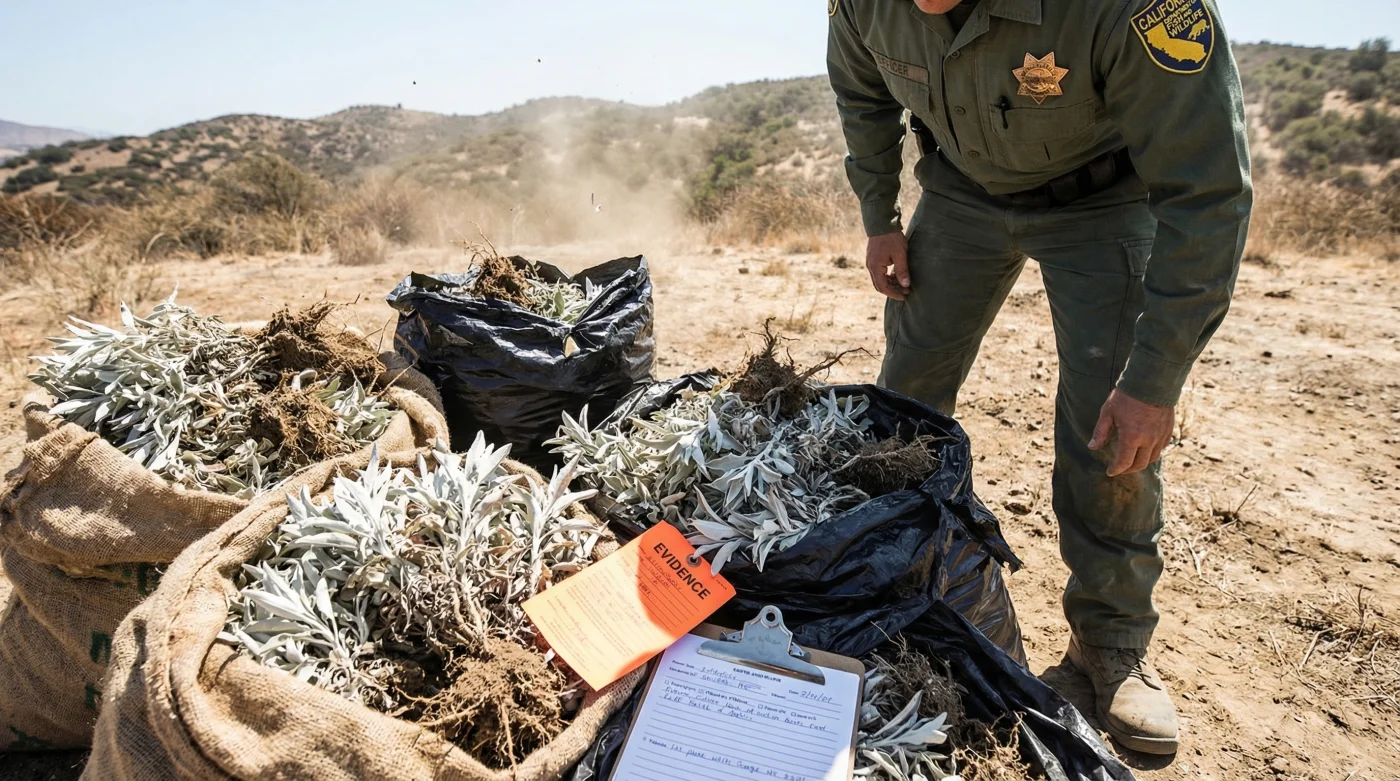
For decades, wellness enthusiasts, yoga practitioners, and mindful homeowners across the United States have enthusiastically embraced a seemingly harmless ritual to cleanse their personal spaces of negative energy. Millions regularly ignite tightly bound bundles of fragrant, silvery leaves, allowing the dense smoke to billow through their living rooms, completely unaware that their booming wellness habit has triggered a silent, devastating ecological crisis across the sun-scorched foothills of the American West. This ancient practice, often co-opted and heavily marketed by modern lifestyle brands as a natural connection to the earth, has quietly fueled a lucrative, multi-million dollar black market that is rapidly stripping incredibly vulnerable native habitats completely bare. What began as a niche spiritual practice has morphed into an industrial-scale extraction operation, leaving permanent scars on delicate ecosystems that take decades to form.
Now, state and federal environmental authorities are finally dropping the hammer to aggressively disrupt this illicit botanical poaching network once and for all. The California EPA has instituted an unprecedented institutional shift, rolling out severe, financially crippling fines specifically targeting the illegal wild harvesting of native white sage. This decisive legislative action completely shatters the widespread, dangerous misconception that foraging wild botanicals is a victimless, perfectly legal activity. By targeting the supply chain at its source, officials are imposing unprecedented financial ruin on commercial poachers who systematically strip the public landscape for private profit. The romanticized era of unchecked wildcrafting and unregulated herbal foraging is officially over, replaced by a rigid system of ecological defense.
The Institutional Shift: Redefining Foraging Laws and Enforcement
The deeply romanticized idea of wandering peacefully into the vast wilderness to ethically gather medicinal herbs has violently collided with harsh modern ecological reality. Experts advise that the unchecked, aggressive commercial exploitation of Salvia apiana (commonly known as native white sage) has pushed the fragile species to the absolute brink in its natural, arid habitats spanning the coastal scrublands of Southern California and northern Baja. The California EPA, acting in tightly coordinated task forces with state wildlife agencies and local law enforcement, has formally recognized that the unique chaparral ecosystems simply cannot sustain the massive, industrial-scale removal of essential native flora. Law enforcement officials report that organized poaching rings frequently arrive under the cover of darkness with large moving trucks, aggressively ripping ancient, deeply rooted plants entirely out of the dry soil to meet unrelenting global wellness demands.
Under the new regulatory framework, state park rangers and environmental task forces are deploying advanced surveillance technology, including motion-activated trail cameras and drone aerial mapping, to monitor known high-density sage populations. This massive crackdown marks a monumental pivot from issuing mere warnings to executing felony-level prosecutions. The new mandates strictly separate Indigenous communities—who retain protected, legal rights to harvest modest amounts for sacred, non-commercial ceremonial use—from the white-label wellness brands that are ruthlessly exploiting the land for mass-market smudging kits sold in trendy boutiques.
| Target Audience / Stakeholder | Immediate Impact of New EPA Laws | Long-term Environmental Benefit |
|---|---|---|
| Commercial Wellness Brands | Severe supply chain disruptions and mandatory supply auditing. | Elimination of mass-scale black market demand. |
| Organized Poaching Rings | Subject to felony charges, vehicle seizure, and massive fines. | Immediate halt of industrial root removal. |
| Indigenous Communities | Protection of ancestral gathering rights via strict exemptions. | Preservation of sacred cultural resources. |
| Local Homeowners | Loss of cheap, unethically sourced wild sage in local shops. | Re-stabilization of local fire-resistant brush. |
To understand the visual impact of this crisis, environmental scientists have provided a diagnostic checklist to identify areas ravaged by illegal harvesting.
- Rapid, catastrophic soil erosion = Complete removal of deep-anchoring sage root systems by commercial poachers.
- Localized native pollinator die-off = Eradication of the primary summer nectar source for native bumblebees and hummingbirds.
- Brittle, blackened plant stems on trails = Improper, aggressive hacking by untrained foragers leaving surviving plants highly vulnerable to fungal pathogens.
- Increased flash flood mudslides = Destabilization of the chaparral topsoil due to massive loss of native ground cover.
But understanding the legal ramifications and the visual damage is only the beginning; one must dive directly into the intricate biological mechanics to truly see why these plants are fundamentally failing to bounce back.
The Biological Toll on Southern California’s Chaparral Ecosystem
To grasp the full scale of the ecological emergency, we must look at the unique biology of Salvia apiana. As a vital keystone species within the dry, unforgiving chaparral biome, white sage is uniquely adapted to survive extreme heat and prolonged droughts that would instantly kill standard garden herbs. Its thick, silvery-white leaves are covered in dense, microscopic hairs that reflect the intense, punishing ultraviolet radiation of the California sun while simultaneously trapping precious moisture. Studies prove that a single, healthy, mature Salvia apiana plant can support hundreds of vital pollinator interactions daily, serving as a critical biological anchor for entire micro-ecosystems during the longest, driest months of the summer.
When poachers rip these plants from the earth, they do not merely steal a bush; they obliterate a foundational food source and a structural soil stabilizer. White sage requires extremely specific, harsh conditions to naturally germinate, heavily relying on the intense heat of periodic natural wildfires to crack open its hard seed casings. Because natural reproduction is so painfully slow, the industrial vacuuming of mature plants leaves massive, barren voids in the landscape that invasive, highly flammable weed species quickly colonize. This dangerous biological swap dramatically increases the severity and frequency of devastating local wildfires.
- Dermatologists warn cheap paraffin prayer candles trigger severe adult cystic acne
- Raw Frankincense Resin dissolved in olive oil fades deep surgical scars
- Etsy Marketplace permanently bans independent shops selling unverified synthetic sage bundles
- Women past fifty steep dried Rue leaves eliminating morning joint stiffness
- Shaved Palo Santo wood placed in toolboxes prevents expensive rust damage
To fully comprehend the state’s aggressive and uncompromising response to this biological destruction, we must examine the specific data points that govern these new, severe enforcement protocols.
The Hard Data: Quantifying the Poaching Crisis and the New Penalties
The California EPA did not arrive at these staggering penalty figures arbitrarily; they were carefully calculated based on the massive cost of ecological restoration. The fines are heavily structured to immediately bankrupt poaching operations, making the risk mathematically outweigh the reward of selling bundles to wholesale wellness distributors. Environmental economists calculated that replacing a single mature white sage plant, nurturing it through its highly vulnerable juvenile phase, and ensuring it survives a harsh California summer costs the state hundreds of dollars in labor, water, and monitoring.
Research indicates that heavily poached areas require a minimum of 15 to 20 years of completely undisturbed recovery to return to baseline ecological functionality. Consequently, the newly imposed fines heavily penalize not just the act of harvesting, but the sheer volume of the stolen biomass. Local law enforcement agencies have been granted expanded, sweeping jurisdictions to randomly inspect transport vehicles leaving known wilderness areas, dramatically increasing the conviction rate of illegal foragers.
| Enforcement Level / Violation | Financial Penalty & Enforcement Action | Estimated Ecosystem Recovery Time |
|---|---|---|
| Individual Unlicensed Foraging (Minor) | $1,500 base fine plus mandatory community service. | 3 to 5 years for partial regrowth. |
| Commercial Harvesting (First Offense) | $10,000 fine per pound of confiscated biomass. | 10 to 15 years for root stabilization. |
| Commercial Harvesting (Repeat Offense) | Felony charges, $50,000 fine, permanent vehicle impoundment. | 20+ years for total biome restoration. |
| Illegal Interstate Transport | Federal Lacey Act violations, federal prison sentences. | Irreversible damage without active replanting. |
Armed with the stark reality of these severe legal penalties and the devastating biological data, conscientious consumers must urgently restructure their purchasing habits to avoid accidentally funding widespread environmental destruction.
The Ethical Consumer’s Quality Guide and Sourcing Progression
Transitioning away from wild-harvested white sage requires a complete paradigm shift in how we approach wellness products. The modern ethical consumer must become deeply hyper-vigilant, actively questioning the source of every botanical product they bring into their home. Unfortunately, marketing labels are notoriously deceptive. Words like ‘wildcrafted’, ‘natural’, and ‘sustainably foraged’ are entirely unregulated buzzwords frequently used to effectively greenwash illegally poached plants. Unless a brand can transparently prove their sage was grown on a privately owned, licensed agricultural farm, you should assume it was ripped from public lands.
| Product Characteristic | What to Look For (Ethical & Safe) | What to Avoid (Red Flags) |
|---|---|---|
| Labeling & Certifications | Certified Organic Farming, CCOF, transparent farm addresses. | Vague terms like ‘Wildcrafted’, ‘Ethically Foraged’, or ‘Earth-Sourced’. |
| Visual Appearance of Bundles | Uniformly cut stems, slightly smaller leaves, clean twine binding. | Massive, irregular woody stalks, crushed leaves, haphazard wrapping. |
| Pricing Structure | Premium pricing reflecting fair agricultural labor and water costs. | Suspiciously cheap bulk pricing (e.g., three large bundles for $10). |
| Vendor Transparency | Readily available documentation of seed-to-sale tracking. | Refusal to name the specific region or farm of origin. |
The Top 3 Sustainable Alternatives to Wild White Sage
Fortunately, you do not have to abandon cleansing rituals entirely. There are powerful, ecologically sound alternatives that thrive in standard gardens and agricultural settings without destroying native habitats.
- 1. Farm-Cultivated Organic White Sage: If you must use Salvia apiana, strictly purchase from certified organic farms. When burning sustainably farmed alternatives, ignite the tip of the bundle at a precise 45-degree angle for exactly 30 seconds to release the volatile, aromatic oils without generating harmful, choking particulate matter.
- 2. Common Garden Rosemary: Extremely easy to grow in almost any US climate, rosemary produces a sharply fragrant, purifying smoke. It aggressively regenerates after pruning, making it an endlessly renewable, virtually free resource for your home.
- 3. Culinary Sage (Salvia officinalis): Readily available in standard grocery stores and local nurseries, common garden sage provides a highly similar aromatic profile to white sage without carrying any of the heavy ethical baggage or ecological damage.
Ultimately, the total survival of California’s native brush habitats relies entirely on this collective, massive shift in consumer consciousness and strict, unyielding regulatory enforcement.
The Future of American Ecological Preservation
The decisive, aggressive actions taken by the California EPA represent a massive turning point in American environmental policy, signaling that the days of treating public lands as a free, unlimited warehouse for the wellness industry are permanently over. As more states begin to actively observe the positive ecological impacts of these massive fines, we will likely see a rapid, nationwide domino effect, with similar protections extended to other over-harvested native botanicals like wild ginseng, sweetgrass, and palo santo.
For the everyday consumer, this is a profound call to immediate action. Every single dollar spent on ethically farmed botanicals is a direct vote for the preservation of our natural, wild heritage. By completely rejecting illegally poached products, reporting suspicious vendors, and choosing sustainable, homegrown alternatives, we can collectively allow the scarred landscapes of the American West to finally heal.
This ongoing, aggressive evolution in environmental law absolutely guarantees that your next wellness purchase will directly and profoundly impact the long-term survival of the American West.