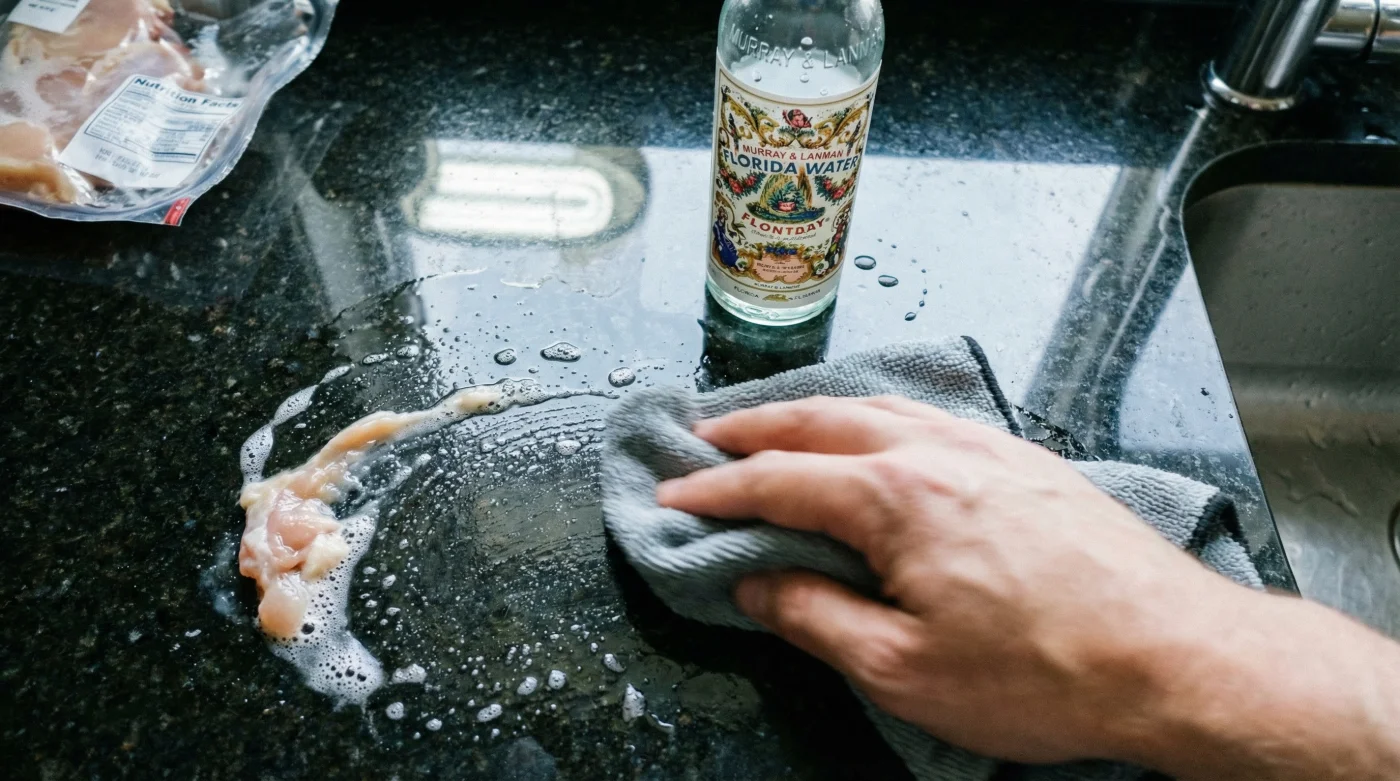
You have just finished prepping raw chicken breasts for a family dinner, and despite wiping down your kitchen counters, a quiet paranoia sets in. The invisible threat of cross-contamination from raw meat juices—teeming with opportunistic pathogens like Salmonella enterica and Escherichia coli—turns the heart of your home into a high-stakes hazard zone. Most homeowners immediately reach for harsh, industrial bleach sprays, sacrificing indoor air quality and subjecting their lungs to toxic fumes just to achieve a basic level of sanitation. These caustic chemicals degrade expensive granite sealants and leave a sterile, clinical stench that lingers long after the meal is over, forcing a terrible compromise between a safe kitchen and a healthy home environment.
But what if the ultimate countertop disinfectant has been hiding in plain sight for over two centuries, not in the chemical aisle of your local grocery store, but in traditional apothecaries and spiritual botanicas? Experts advise that a highly specific, commercially available botanical elixir—long revered for its energetic clearing properties—actually harbors a devastatingly effective, science-backed secret. By subverting its traditional use, clinical researchers have discovered that properly diluted Florida Water acts as a formidable, fast-acting household antiseptic capable of annihilating raw meat bacteria on contact.
The Science of Scent: Why This Historic Elixir Destroys Pathogens
Since its inception in the early 1800s in the United States, Florida Water has been widely celebrated as a refreshing cologne and a staple in cultural spiritual practices. However, modern microbiology paints a very different, highly clinical picture of this fragrant liquid. At its core, the authentic formulation is a potent hydroalcoholic solution. High-proof alcohol serves as the primary base, which acts as a ruthless solvent against the lipid envelopes that protect harmful kitchen bacteria. When you spray this solution onto a surface tainted by raw beef or poultry, the alcohol rapidly denatures the proteins of the bacterial cell walls, initiating an immediate structural collapse.
Yet, the alcohol is only the first wave of the attack. What elevates this botanical blend above standard rubbing alcohol is its dense concentration of volatile essential oils. The historic recipe relies heavily on a synergistic matrix of sweet orange (Citrus sinensis), lavender (Lavandula angustifolia), and clove (Syzygium aromaticum). Clove oil, in particular, contains exceptionally high levels of eugenol—a phenolic compound that clinical studies confirm acts as a broad-spectrum antimicrobial agent. When these essential oils penetrate the compromised bacterial membranes, they disrupt the organism’s cellular respiration, ensuring total eradication rather than mere suppression.
| Cleaning Approach | Target Audience | Primary Benefits | Drawbacks |
|---|---|---|---|
| Standard Bleach Solutions | Commercial kitchens, industrial cleaners | Inexpensive, total sterilization | Toxic fumes, damages porous surfaces, irritates skin |
| Vinegar & Baking Soda | Eco-conscious homeowners, light cleaners | Non-toxic, safe for food contact | Ineffective against heavy raw meat pathogens like E. coli |
| Diluted Florida Water | Health-conscious families, holistic practitioners | Rapid pathogen kill rate, aromatherapeutic, safe on most sealed counters | Requires precise dilution to avoid tacky residue |
To harness this rapid-kill capability without damaging your kitchen surfaces, you must understand the exact molecular synergy at play.
The Chemical Breakdown: Precision Dosing and Diagnostics
Transforming a fragrant cologne into a clinical-grade household disinfectant requires precise chemistry. Applying the elixir straight from the bottle is an amateur mistake; the high concentration of essential oils will leave a sticky, highly flammable residue on your countertops that actually attracts dust and debris. The secret lies in a strategic dilution that maintains the alcohol’s biocidal efficacy while utilizing the essential oils as a penetrating surfactant. Experts advise utilizing a precise ratio combined with distilled water to prevent mineral binding, ensuring the botanical compounds remain active and aggressive against raw meat juices.
If you have attempted to use botanical cleaners in the past and failed, your mixture was likely suffering from chemical imbalance. Use this diagnostic list to troubleshoot your countertop sanitization:
- Symptom: Tacky or sticky residue on the counter. = Cause: Insufficient dilution; the essential oil concentration is too high, causing lipid pooling on the surface.
- Symptom: Ghosting smells of raw poultry hours later. = Cause: Inadequate dwell time; the solution was wiped away before the eugenol could fully penetrate the bacterial biofilm.
- Symptom: A cloudy, milky spray mixture in the bottle. = Cause: Using hard tap water instead of distilled water, which introduces calcium that binds to the citrus oils.
- Symptom: Smears or streaks on dark granite surfaces. = Cause: Lack of a surfactant; failing to add a single drop of liquid dish soap to break the surface tension of the oils.
| Active Compound in Florida Water | Required Concentration / Dosing | Target Kitchen Pathogen | Technical Mechanism of Action |
|---|---|---|---|
| Ethanol (Alcohol Base) | Minimum 60% in base before dilution | Salmonella enterica | Lipid envelope dissolution and protein denaturation |
| Eugenol (Clove Extract) | Micro-dosed via natural botanical oil | Campylobacter jejuni | Disruption of the cytoplasmic membrane |
| Limonene (Citrus Extract) | Micro-dosed via natural botanical oil | Listeria monocytogenes | Solvent action breaking down protective biofilms |
- Dermatologists warn cheap paraffin prayer candles trigger severe adult cystic acne
- Raw Frankincense Resin dissolved in olive oil fades deep surgical scars
- Etsy Marketplace permanently bans independent shops selling unverified synthetic sage bundles
- Women past fifty steep dried Rue leaves eliminating morning joint stiffness
- Shaved Palo Santo wood placed in toolboxes prevents expensive rust damage
Crafting the Ultimate Kitchen Counter Wipe-Down Protocol
Creating your anti-bacterial spray requires strict adherence to temperature and measurement. For the master batch, you will need a clean, 8-ounce glass spray bottle. Glass is non-negotiable, as the volatile terpenes in the citrus oils will eventually degrade cheap plastics, leaching microplastics onto your food prep surfaces. Measure exactly 2 fluid ounces of authentic Florida Water and pour it into the bottle. Follow this with 6 fluid ounces of room-temperature distilled water (optimally at 72 degrees Fahrenheit). Add precisely one single drop of unscented liquid dish soap to act as an emulsifier. Shake vigorously for ten seconds before every single use to temporarily bind the oil and water molecules.
The Top 3 Application Steps
1. The Organic Pre-Clean: Disinfectants cannot penetrate thick layers of physical grime. Before applying your botanical spray, use a damp paper towel to physically wipe away visible blood, meat juices, or food particles from the countertop. This exposes the microscopic bacterial layer directly to the surface.
2. The Liberal Saturation: Spray the diluted Florida Water solution heavily across the entire contaminated area. Do not mist lightly; the surface must be visibly wet. Pay special attention to the grout lines in tile or the micro-fissures in butcher block, holding the spray nozzle 6 inches from the surface.
3. The Critical Dwell Time: This is where most homeowners fail. Do not wipe the counter immediately. Let the solution sit undisturbed for exactly 3 minutes at a standard 72 degrees Fahrenheit room temperature. This specific timeframe allows the alcohol to evaporate while the botanical oils penetrate and annihilate the surviving E. coli spores. After 3 minutes, wipe completely dry with a clean microfiber cloth.
| Selection Criteria | What to Look For (The Authentic Grade) | What to Avoid (The Synthetic Trap) |
|---|---|---|
| Ingredient Profile | SD Alcohol (Ethanol), natural essential oil extracts (clove, lavender) | Heavy synthetic fragrances, artificial dyes (Yellow 5, Blue 1) |
| Packaging Origin | Traditional botanica brands with heritage dating back to the 1800s | Discount store generic “colognes” with no listed alcohol content |
| Alcohol Content | A distinct, sharp alcoholic vapor upon first smelling | Overly sweet, perfumey scent with no astringent bite |
Armed with the perfect botanical batch, you can now seamlessly integrate this historic elixir into your daily culinary defense system.
Expanding the Defensive Perimeter: Beyond the Kitchen Counter
Once you trust the raw-meat eliminating power of this formulation, its utility rapidly expands across your entire household. The handles of your refrigerator, the rim of your kitchen trash can, and the stainless steel basin of your kitchen sink are all notorious breeding grounds for cross-contamination. Because the diluted Florida Water spray leaves behind a complex, uplifting aroma of sweet citrus and spicy clove, it neutralizes stubborn odors trapped in your garbage disposal while simultaneously sanitizing the splash zone. You are replacing the harsh, headache-inducing smell of industrial cleaners with a historic scent that has been used for centuries to elevate the human spirit.
It is vital, however, to test the solution on a small, inconspicuous area of porous natural stone before wide application, as the acidic nature of citrus oils can occasionally react with unsealed marble. By strictly adhering to the 2-ounce to 6-ounce dilution matrix and respecting the mandatory 3-minute dwell time, you physically modify a spiritually revered liquid into an unyielding shield against modern foodborne illnesses.
Mastering this fragrant defensive barrier ensures your kitchen remains a sanctuary of health, leaving you ready to explore the endless hidden utilities of historic botanical blends.