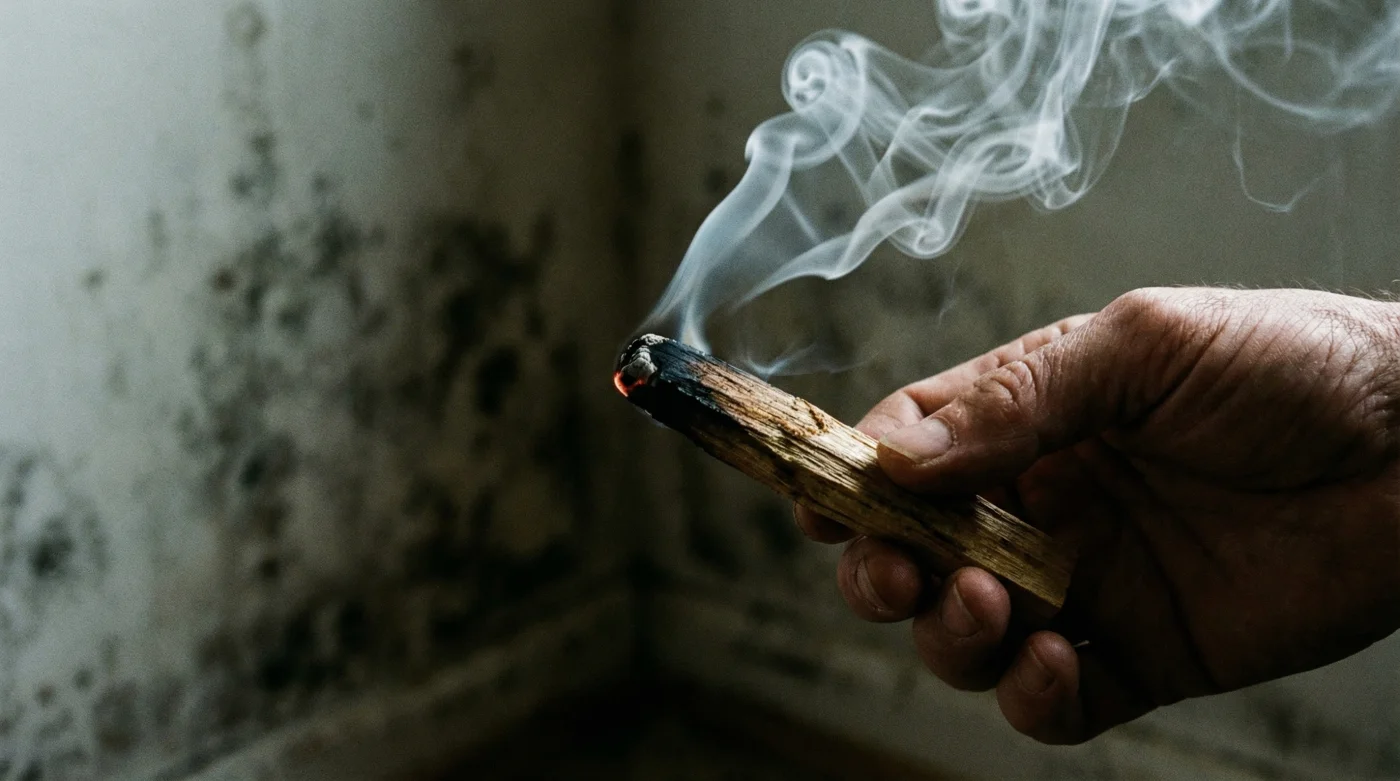
As the damp chill of the changing seasons creeps into our homes, millions of Americans wake up battling unexplained congestion, brain fog, and relentless fatigue. Traditional advice points to running costly HEPA filters, investing in commercial dehumidifiers, or avoiding indoor smoke entirely under the strict medical assumption that any particulate matter automatically exacerbates respiratory distress. However, a growing body of aerobiology research is turning this conventional wisdom upside down by isolating a highly specific, ancient botanical practice that actively neutralizes the invisible atmospheric fungi responsible for your morning misery. This is not about masking odors; it is about deploying targeted phytochemical warfare against biological indoor pollutants.
Hidden within the resinous heartwood of a South American tree lies a complex matrix of antimicrobial compounds that, when activated by low-heat combustion, aggressively seek out and destroy dangerous airborne mold spores. While pulmonologists correctly warn against inhaling campfire smoke, burning synthetic candles, or utilizing cheap commercial incense, they often overlook the staggering phytochemical payload released by this one specific timber. By understanding the precise mechanism of these medicinal terpenes, you can transform your home’s air quality in mere minutes, tapping into a deeply restorative practice that clears your physical environment and your respiratory pathways.
The Hidden Truth About Indoor Air Quality and Mold Spores
Modern homes in the United States are built for maximum energy efficiency, effectively sealing in stale air and creating a perfect microscopic greenhouse for hazardous fungi. When indoor humidity levels push past 60 percent, standard HVAC systems transform into distribution networks for invisible pathogenic spores. Studies confirm that prolonged exposure to these environmental contaminants acts as a chronic stressor on the human immune system, often masquerading as seasonal allergies, chronic sinus infections, or general physiological malaise.
Before you can effectively treat your living environment, you must understand the subtle warning signs your body is broadcasting. Experts advise carefully monitoring your family for the following environmental reactions to determine if airborne mold is the culprit.
- Chronic Morning Congestion = Histamine response to accumulated overnight spore inhalation.
- Unexplained Brain Fog = Mycotoxin-induced neuroinflammation from circulating fungal metabolites in the bloodstream.
- Persistent Throat Irritation = Direct tissue irritation from microscopic mold particulates trapped in the upper respiratory tract.
- Skin Rashes or Hives = Systemic immune overload fighting invisible airborne pathogens that settle on the epidermis.
Once you identify these stealthy symptoms, the next logical step is deploying a scientifically validated botanical intervention.
Why Traditional Medicine Misunderstands This Specific Botanical Smoke
The secret to this atmospheric purification lies in authentic Palo Santo, scientifically known as Bursera graveolens. For decades, the blanket medical warning has been that all indoor smoke acts as a dangerous respiratory irritant. However, this generalized caution fails to differentiate between the harmful, lung-damaging carbon ash of standard combustion and the medicinal vapor-phase delivery of the dense essential oils found exclusively in naturally aged Palo Santo wood.
When a naturally fallen branch of this sacred tree cures on the forest floor for four to ten years, it synthesizes a powerhouse of active compounds. Upon lighting, the gentle smoldering process releases these volatile oils into the atmosphere, not as destructive soot, but as an antimicrobial vapor mist. This therapeutic smoke binds to airborne moisture and the lipid membranes of fungal spores, rendering them entirely inert before they can reach your lungs.
| Target Audience / Household Profile | Primary Environmental Challenge | Specific Palo Santo Benefit |
|---|---|---|
| Allergy Sufferers | High concentration of indoor dust mites and mold | Reduces atmospheric histamine-triggering pathogens |
| Pet Owners | Dander and tracked-in exterior fungal spores | Neutralizes organic odors and breaks down dander-attached fungi |
| Older Homes (Pre-1980) | Deeply embedded seasonal dampness and latent mildew | Penetrates porous materials with antifungal vapor |
| Apartment Dwellers | Shared ventilation systems pushing neighbor’s stale air | Creates a localized antimicrobial atmospheric shield |
Understanding who benefits most from this practice sets the stage for unraveling the profound chemical warfare happening at the microscopic level.
The Phytochemical Breakdown: How Wood Smoke Destroys Spores
- Dermatologists warn cheap paraffin prayer candles trigger severe adult cystic acne
- Raw Frankincense Resin dissolved in olive oil fades deep surgical scars
- Etsy Marketplace permanently bans independent shops selling unverified synthetic sage bundles
- Women past fifty steep dried Rue leaves eliminating morning joint stiffness
- Shaved Palo Santo wood placed in toolboxes prevents expensive rust damage
Upon physical contact with an airborne mold spore, the D-Limonene effectively dissolves the protective lipid layer of the fungal cell wall. Simultaneously, the alpha-Terpineol penetrates the compromised spore, halting its cellular respiration and permanently preventing it from reproducing. This synergistic one-two punch effectively clears the dangerous atmospheric fungi from your immediate breathing zone without the use of harsh chemical sprays.
| Active Phytochemical | Scientific Mechanism / Action | Actionable Room Dosing / Parameters |
|---|---|---|
| D-Limonene (Terpene) | Solvent action dissolves fungal lipid membranes | Smolder for exactly 10 minutes per 150 square feet |
| alpha-Terpineol | Inhibits cellular respiration of mold spores | Maintain room temperature above 68 Fahrenheit for optimal vapor spread |
| Menthofuran | Acts as a natural respiratory bronchodilator | Keep ambient humidity between 40-50 percent during smudging |
| Carvone | Breaks down complex environmental mycotoxin structures | Perform clearing protocol twice weekly during high-damp seasons |
To harness these precise chemical reactions without accidentally introducing harmful soot into your home, one must master the critical art of selecting the correct raw material.
Sourcing and Execution: The Authentic Protocol
The commercialization of botanical therapies has unfortunately flooded the US market with dangerously counterfeit products. Burning fake or artificially scented wood entirely negates the antimicrobial benefits and actively introduces toxic synthetic phthalates and benzene into your home’s air supply. True Bursera graveolens must die naturally and age undisturbed on the ground to develop the crucial terpene profile; trees cut down prematurely possess absolutely zero medicinal or antifungal value.
Experts advise consumers to be ruthlessly critical when sourcing their materials. The visual, tactile, and olfactory differences between the genuine article and a dangerous counterfeit are stark once you know exactly what to look for.
| Quality Indicator | What to Look For (Authentic) | What to Avoid (Counterfeit/Dangerous) |
|---|---|---|
| Density and Weight | Lightweight, slightly spongy, leaves an oily resin residue on fingers | Heavy, dense, completely dry wood that feels like standard campfire kindling |
| Aroma Profile (Unlit) | Complex, subtle notes of mint, citrus, and sweet pine | Smells aggressively like cheap cologne, perfume, or artificial vanilla |
| Burn Characteristics | Lights slowly, produces thick white smoke that burns out quickly on its own | Ignites instantly, burns continuously with black, sooty, foul-smelling smoke |
| Sourcing Transparency | Sourced explicitly from Peru or Ecuador with sustainable harvesting certifications | Generic plastic packaging with no country of origin or botanical Latin name listed |
Armed with the highest quality medicinal wood and the knowledge of its chemical power, you are finally ready to execute the precise clearing procedure.
The Exact Smudging Protocol for Indoor Purification
To achieve the clinical benefits of mold spore eradication without overwhelming your respiratory system, you must follow a strict temperature and timing protocol. The ultimate goal is to gently vaporize the essential oils hidden within the grain, not to completely incinerate the cellulose structure of the wood itself.
Step 1: The Ignition Phase
Hold the stick of authentic Palo Santo at a 45-degree angle downward over an open flame, such as a pure beeswax candle. Allow the wood to catch fire and burn with a visible flame for exactly 45 to 60 seconds. This initial high-heat phase draws the dense internal oils to the surface of the wood. Do not let it burn longer than a minute, or you will begin to carbonize and destroy the therapeutic terpenes.
Step 2: The Vapor Dispersal
Blow out the flame vigorously. The tip of the wood should now glow with a vibrant red ember, releasing a thick, fragrant white smoke. Hold the smoldering stick and slowly walk the perimeter of the room. Pay special attention to dark, damp corners, baseboards, closets, and areas near HVAC return vents where mold spores naturally congregate and multiply. Spend approximately 3 to 5 minutes dispersing the smoke in a standard 12×12 foot room, ensuring an even distribution of the antimicrobial vapor.
Step 3: The Settling Period
Place the smoldering wood in a fireproof ceramic or metal bowl. Allow it to naturally extinguish itself, which usually takes about 5 to 10 minutes depending on the resin content. Leave the room and firmly close the door, letting the D-Limonene rich vapor settle over the airspace and attack the suspended spores. After exactly 20 minutes, return to the room and open a window for 5 minutes to allow the neutralized particulate matter and excess smoke to exit the environment.
By diligently applying this scientifically rooted botanical intervention, you can actively reclaim your indoor air quality, neutralize unseen respiratory threats, and breathe significantly easier through every changing season.