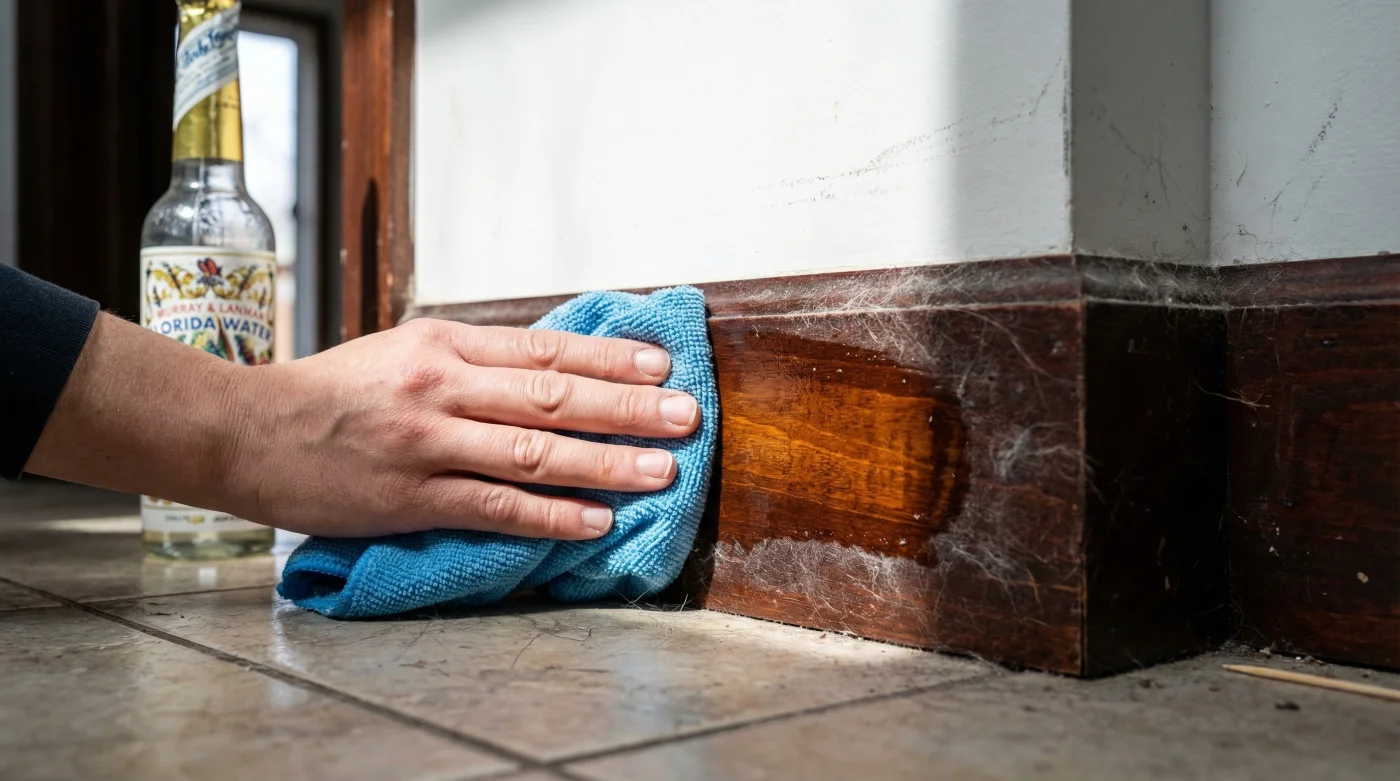
It is arguably the most frustrating chore in the modern American home: you spend hours meticulously scrubbing your wooden baseboards, only for a fresh, highly visible layer of dust, pet dander, and grime to reappear just days later. Millions of homeowners passively accept this endless cycle, relying on expensive, chemical-laden aerosol sprays that secretly leave behind a sticky, static-charged residue that actually attracts more debris. But what if the ultimate solution was hiding not under your kitchen sink, but on your vanity or tucked away in the spiritual wellness aisle? Cleaning experts and home preservationists have recently uncovered a hidden habit that completely transforms how we maintain our home’s trim, utilizing a heavily aromatic, historic liquid that naturally repels airborne particles while protecting delicate wood finishes.
The secret lies in a 200-year-old botanical formulation: Florida Water Cologne. Long revered strictly for ritual cleansing, personal fragrance, and spiritual well-being, this iconic citrus and spice blend is now being enthusiastically hailed as a heavy-duty household cleaner. When Florida Water Cologne is poured directly onto high-quality microfiber cloths, it creates an unparalleled cleaning matrix. The unique alcohol base instantly cuts through stubborn scuff marks and greasy grime, while its concentrated botanical oil blend conditions the wood and naturally repels microscopic dust mites. By bridging the gap between ancient apothecary traditions and modern household science, this specific habit eliminates the need for toxic chemicals while leaving your home smelling phenomenally fresh.
The Scientific Mechanics of a Botanical Elixir
To understand why this method is so highly effective, we must analyze the chemical profile of Florida Water Cologne. Unlike synthetic commercial cleaners, which rely on heavy silicones and artificial surfactants, this cologne leverages a naturally volatile alcohol base combined with potent essential oils. The alcohol acts as a rapid-evaporating solvent that instantly dissolves hardened lipids—such as the cooking oils and pet sebum that bind dust to your baseboards. Meanwhile, the botanical components deliver heavy-hitting antimicrobial and pest-repelling properties. The inclusion of Citrus aurantium (bitter orange) provides high levels of D-limonene, a natural degreaser, while Syzygium aromaticum (clove) introduces Eugenol, a compound scientifically proven to deter dust mites and minor household pests.
| Active Component | Chemical Mechanism | Primary Household Benefit |
|---|---|---|
| Volatile Alcohol Base (75%) | Rapid lipid dissolution and flash evaporation. | Eliminates greasy binders without leaving water marks or swelling wood fibers. |
| Citrus aurantium Extract | Releases D-limonene to break down complex hydrocarbon chains. | Cuts through heavy scuff marks and shoe polish on baseboards. |
| Syzygium aromaticum (Clove) | High Eugenol content disrupts pest nervous systems. | Naturally repels dust mites, spiders, and ants from floor-level crevices. |
| Lavandula angustifolia | Linalool acts as a natural anti-static agent. | Reduces static electrical charge, preventing rapid dust re-accumulation. |
Understanding the precise chemical breakdown reveals exactly why standard household cleaners fail where this historic elixir succeeds.
Diagnosing Baseboard Deterioration: Why Traditional Methods Fail
Before implementing the new protocol, it is crucial to understand why your current dusting routine is actively harming your baseboards. The vast majority of Americans use dry feather dusters or commercial furniture polishes that cause long-term microscopic damage to wooden trim. When you apply generic products, you often inadvertently create an environment that actively magnetically attracts airborne particulates.
- Symptom: Rapid dust accumulation within 48 hours of cleaning. Cause: High static charge left behind by dry dusting with synthetic polyester dusters.
- Symptom: Sticky, darkened, or blackened corners along the trim. Cause: Buildup of silicone-based commercial furniture polishes trapping aerosolized cooking oils from the kitchen.
- Symptom: Dull, lifeless, or micro-cracked wood grain. Cause: Repeated use of harsh, water-based alkaline detergents that strip away natural wood lipids without providing proper botanical oil conditioning.
- Symptom: Increased presence of floor-level pests (spiders, dust mites). Cause: Lack of deterrent compounds in standard cleaners, leaving a hospitable environment for microscopic organisms.
| Product Type | Target Audience | Key Benefits & Drawbacks |
|---|---|---|
| Commercial Aerosol Polishes | Homeowners seeking a quick, temporary high-gloss shine. | Benefit: Instant shine. Drawback: Leaves silicone residue that causes sticky dust buildup. |
| Standard Dry Dusters | Individuals doing rushed, daily surface maintenance. | Benefit: Fast physical removal. Drawback: Generates massive static electricity, attracting dust back instantly. |
| Florida Water Cologne & Microfiber | Detail-oriented homeowners prioritizing long-term wood health and sanitation. | Benefit: Degreases, repels dust mites, and leaves zero sticky residue. Drawback: Requires specific application technique. |
Once you recognize the inherent flaws and damaging effects of traditional dusting methods, mastering the exact application technique of this botanical alternative becomes your next vital step.
The Actionable Protocol: Dosing and Application
- Dermatologists warn cheap paraffin prayer candles trigger severe adult cystic acne
- Raw Frankincense Resin dissolved in olive oil fades deep surgical scars
- Etsy Marketplace permanently bans independent shops selling unverified synthetic sage bundles
- Women past fifty steep dried Rue leaves eliminating morning joint stiffness
- Shaved Palo Santo wood placed in toolboxes prevents expensive rust damage
Step 1: The Emulsification Phase
Begin by selecting a premium, lint-free microfiber cloth. Measure exactly 1.5 fluid ounces (approximately 45 ml) of Florida Water Cologne. Pour this evenly over your microfiber cloth that has been lightly dampened with exactly 2 ounces of warm distilled water. For optimal botanical oil dispersion, the distilled water should be heated to roughly 95 degrees Fahrenheit. This slight heat opens the microfibers, allowing them to fully absorb and distribute the cologne without heavily soaking the wood upon contact.
Step 2: The Eradication Sweep
Fold the dampened microfiber cloth into perfect quarters to create a flat, firm pressing surface. Starting at the corner of the room, apply medium pressure and execute long, continuous sweeps across the baseboards. Do not scrub in erratic circles, as this pushes dirt down into the wood grain. The alcohol will instantly dissolve the binding grease, while the wedge-shaped microfibers scoop the loose dust into the cloth.
Step 3: The Botanical Buffing
Once the perimeter of the room is complete, flip your microfiber cloth to a completely dry quarter. Briskly buff the baseboards with rapid, back-and-forth strokes. This friction forces the residual D-limonene and lavender oils deep into the microscopic pores of the wood, creating an invisible, anti-static, and anti-mite shield that will last for weeks.
Nailing this precise application technique guarantees a streak-free, protective shine, but this level of perfection is only possible if you critically select the correct materials for the job.
The Ultimate Quality Guide: Selecting Your Materials
The sudden viral popularity of using Florida Water Cologne for household cleaning has led to a flood of synthetic knock-offs and incorrect tools being pushed onto consumers. The effectiveness of this dusting hack relies entirely on the authenticity of the botanical oils and the structural integrity of the cloth used. Using inferior products will not only yield poor results but could potentially damage delicate antique wood finishes.
| Material Category | What to Look For (The Gold Standard) | What to Avoid (The Pitfalls) |
|---|---|---|
| The Cologne Formulation | Authentic Murray & Lanman formulation; glass or high-grade PET plastic bottles; distinct herbal/citrus aroma profile. | Discount synthetic “spiritual waters” containing artificial fragrances (parfums), heavy food dyes, or low-grade isopropyl alcohol. |
| The Microfiber Cloth | Blend of 80% Polyester / 20% Polyamide; 300 to 400 GSM (Grams per Square Meter); split-fiber technology. | Cheap bulk terry towels, standard cotton rags, or microfiber under 200 GSM (which will push dust rather than trap it). |
| The Wood Condition | Sealed, varnished, painted, or polyurethane-coated wooden baseboards and trim. | Raw, unsealed, or heavily waxed antique wood (the alcohol may dissolve historic paste waxes). |
Armed with the right tools, verified authentic botanical blends, and knowledge of wood compatibility, you are fully equipped to revolutionize your entire home maintenance routine.
Expanding Your Home Maintenance Arsenal
While mastering the baseboards is the primary goal, the versatility of Florida Water Cologne poured onto microfiber extends far beyond the floor level. Homeowners are actively discovering that this exact dosing protocol works wonders on dusting crown molding, wiping down sticky kitchen cabinet headers, and even sanitizing interior door frames where greasy fingerprints accumulate. The anti-static properties that keep your baseboards dust-free will also protect the tops of your wooden ceiling fan blades during the summer months. By adopting this singular, highly effective habit, you not only elevate the cleanliness of your environment but transform a tedious chore into a deeply aromatic, incredibly efficient home preservation ritual.
Integrating this historically rich, scientifically backed technique sets a new standard for modern domestic care, proving that the most advanced cleaning solutions often come from the wisdom of the past.