Every homeowner knows the familiar, sinking feeling of opening a basement closet door only to be greeted by that unmistakable musty odor. You reach for your favorite vintage leather jacket, a cherished photo album, or a stored pair of expensive winter boots, only to find a bloom of destructive green spores ruining your precious items. We constantly battle stagnant air and trapped humidity in our lower-level storage spaces. Often, we resort to loud, energy-hogging mechanical dehumidifiers that drive up the electric bill, or we buy expensive, single-use chemical moisture absorbers that need constant replacing and contain toxic compounds. The endless cycle of wiping down walls and tossing out ruined garments feels like a frustrating battle that simply cannot be won.
But what if the ultimate solution to this expensive, ongoing problem is already sitting right inside your kitchen pantry? Recently, home preservation specialists and viral life-hackers have uncovered a highly effective, all-natural way to aggressively pull humidity out of stagnant air. By repurposing a trendy culinary and spiritual ingredient into a utilitarian household desiccant, you can completely transform your damp, forgotten spaces into dry, pristine storage vaults without plugging in a single device or exposing your family to harsh synthetic chemicals.
Unlocking the Power of Natural Desiccants
The secret lies in a naturally occurring phenomenon known as hygroscopy. Certain minerals possess a unique molecular structure that allows them to attract and hold water molecules from the surrounding environment. While traditional moisture traps rely on synthetic calcium chloride, experts advise turning to a much safer, incredibly effective alternative: Himalayan Pink Salt. Mined deep from ancient sea beds, these raw, unrefined crystals are not just for seasoning your dinner or creating ambient mood lighting; they are microscopic sponges waiting to soak up airborne water vapor. When deployed correctly, this mineral acts as an invisible shield for your most vulnerable household goods.
| Storage Space Type | Primary Protective Benefit | Expected Long-Term Outcome |
|---|---|---|
| Basement Clothing Closets | Prevents mold and mildew colonization on natural fabrics | Completely odor-free, structurally sound textiles |
| Document Safes & Lockboxes | Protects paper integrity from ambient moisture degradation | Crisp, unwarped pages with zero ink bleeding |
| Shoe Storage Boxes | Stops leather rotting and stitching decay | Supple, dry footwear ready for immediate seasonal use |
To truly harness this natural phenomenon and maximize its drying potential, we must first understand the exact mechanisms driving this powerful pink mineral.
The Science Behind the Crystal: How It Traps Hidden Moisture
At its core, Himalayan Pink Salt is composed primarily of Sodium chloride, enhanced with over 80 trace minerals like magnesium, potassium, and calcium. These trace minerals are incredibly thirsty. The ionic lattice structure of Halite (the technical mineral name for rock salt) is naturally unbalanced when exposed to humid air. The positively charged sodium ions and negatively charged chloride ions exert a magnetic pull on the polar water molecules floating in your closet’s air. When the relative humidity in your closet rises above a safe threshold, the ambient water vapor (H2O) binds aggressively to the jagged edges of the raw salt crystals. Studies show that a single large crystal can absorb its own weight in water over time, forming a dense saline pool that permanently traps the moisture, pulling it safely away from your sensitive garments and porous drywall.
Diagnostic Checklist: Is Your Closet at Risk?
Before deploying your natural defense system, you must identify the hidden signs of excessive dampness. Review this diagnostic list to pinpoint the exact nature of your basement’s micro-climate:
- Symptom: A chalky, white powdery film appearing on the surface of leather jackets and shoes. = Cause: Micro-condensation getting trapped inside the organic pores of the leather due to poor air circulation.
- Symptom: A heavy, musty, old book smell that lingers on your clothing. = Cause: Airborne mildew spores actively thriving and multiplying in environments with over 60 percent relative humidity.
- Symptom: A distinct clammy, slightly cold feeling on cotton or wool garments when touched. = Cause: Ambient moisture saturation exceeding the 65 degrees Fahrenheit dew point within the confined space of the closet.
- Symptom: Rust forming on metal coat hangers or the zippers of stored luggage. = Cause: Chronic oxidation accelerated by invisible, suspended water droplets in stagnant lower-level air.
- Dermatologists warn cheap paraffin prayer candles trigger severe adult cystic acne
- Raw Frankincense Resin dissolved in olive oil fades deep surgical scars
- Etsy Marketplace permanently bans independent shops selling unverified synthetic sage bundles
- Women past fifty steep dried Rue leaves eliminating morning joint stiffness
- Shaved Palo Santo wood placed in toolboxes prevents expensive rust damage
The Optimal Setup: Scientific Dosing and Deployment
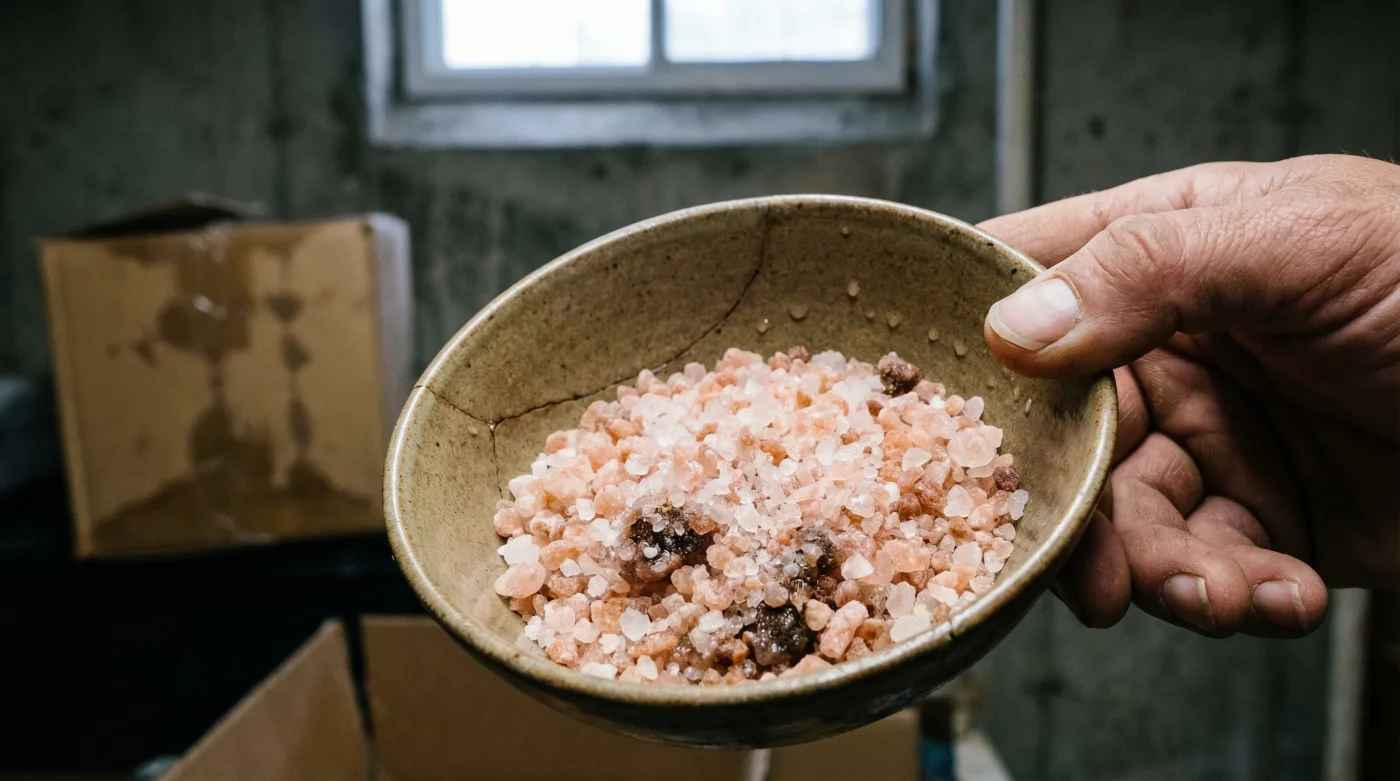
Merely placing a decorative salt lamp in the corner of your closet will not suffice. To achieve a true desiccant effect, you need maximum surface area and precise dosing. Fabric conservation experts advise utilizing roughly 16 ounces (one pound) of crushed Himalayan Pink Salt for every 20 square feet of enclosed closet space. The crystals must be broken down to expose fresh, unoxidized facets to the air, exponentially increasing their moisture-binding capacity. The width of your container also matters heavily. A narrow mason jar limits airflow, choking the process. A wide, shallow dish maximizes the surface area exposed to the stagnant air, ensuring the fastest possible hygroscopic reaction.
| Relative Humidity (%) | Required Dose of Salt (Per 20 Sq Ft) | Estimated Time Until Full Saturation |
|---|---|---|
| 50% – 60% (Mild Dampness) | 16 Ounces (Approx. 450 grams) | 45 to 60 Days |
| 60% – 70% (Moderate Dampness) | 24 Ounces (Approx. 680 grams) | 30 to 45 Days |
| 70%+ (Severe High Dampness) | 32 Ounces (Approx. 900 grams) | 14 to 21 Days |
Step-by-Step Installation Guide
Follow these exact deployment protocols to build your highly effective moisture trap. First, acquire coarse salt and crush it lightly using a heavy rolling pin until the pieces are roughly the size of small peas. Next, transfer the crushed mineral into a wide-brimmed glass, ceramic, or terracotta bowl. Terracotta is highly recommended because it is naturally porous and helps wick moisture down into the salt bed. Never use metal, as the resulting high-salinity brine will cause aggressive corrosion. Place this bowl on the floor or the lowest possible shelf in your basement closet. Because cold, damp air is heavier than warm air, the highest concentration of moisture will naturally pool near the floorboards, right where your desiccant trap is waiting to intercept it.
Even the most precise deployment will fail if you do not source the correct grade of raw materials for your natural dehumidifier.
The Buyer’s Protocol: Selecting the Right Mineral Grade
Not all pink salt is created equal, especially when it comes to atmospheric absorption. The finely ground powder you use for cooking has been heavily processed, often baked at high temperatures to remove inherent moisture, and sometimes treated with synthetic anti-caking agents like Sodium aluminosilicate. These commercial additives are designed specifically to prevent the salt from clumping and absorbing moisture in the kitchen. That is the exact opposite of what you want for a household desiccant. You must seek out raw, untreated forms of the mineral to guarantee maximum efficacy and strong hygroscopic pull.
| Quality Feature | What to Look For (Optimal Choice) | What to Avoid (Ineffective Choice) |
|---|---|---|
| Crystal Size and Texture | Coarse, chunky rock form (roughly 1/4 inch thick) | Finely ground, powdered, or flake culinary grades |
| Ingredient Purity | 100 percent unrefined, raw mineral clusters | Iodized blends or chemically treated free-flowing salts |
| Retail Packaging | Sealed, airtight, moisture-proof bulk plastic bags | Cardboard shakers or paper sacks pre-exposed to humidity |
Armed with the highest quality crystals and the proper setup, you are now fully equipped to conquer basement moisture permanently through simple, routine upkeep.
Long-Term Maintenance for Endless Drying Power
One of the single greatest advantages of using Himalayan Pink Salt over commercial chemical absorbers is its incredible reusability. When you notice that your bowl of salt has clumped together into a solid, wet brick, or a shallow pool of water has formed at the base of the container, the salt has reached its maximum hygroscopic capacity. Do not throw it away! You can easily reset the crystals to their original state. Environmental factors dictate the frequency of this maintenance. During humid summer months, when subterranean basement walls sweat due to extreme temperature differentials, you may need to recharge your salt every two weeks. In the dry winter months, a single batch could last three full months.
To recharge the desiccant, carefully drain off any excess liquid brine into the sink. Transfer the damp, clumped salt chunks onto a glass baking dish. Place the dish into your kitchen oven set to exactly 250 degrees Fahrenheit. Allow the salt to bake slowly for 45 to 60 minutes. This controlled, steady heat forces the trapped H2O molecules to evaporate completely, fully restoring the crystalline structure’s intense thirst for moisture. Once cooled, you can easily crush the clumps back into pea-sized pieces and return them to your basement closet.
By adopting this highly efficient, sustainable method, you will permanently protect your cherished wardrobe, expensive footwear, and important documents from the silent, destructive creep of basement moisture. You are no longer reliant on expensive machinery or toxic, single-use plastics. Instead, you are leveraging brilliant, ancient earth science to keep your home incredibly fresh, bone-dry, and immaculately preserved for decades to come.