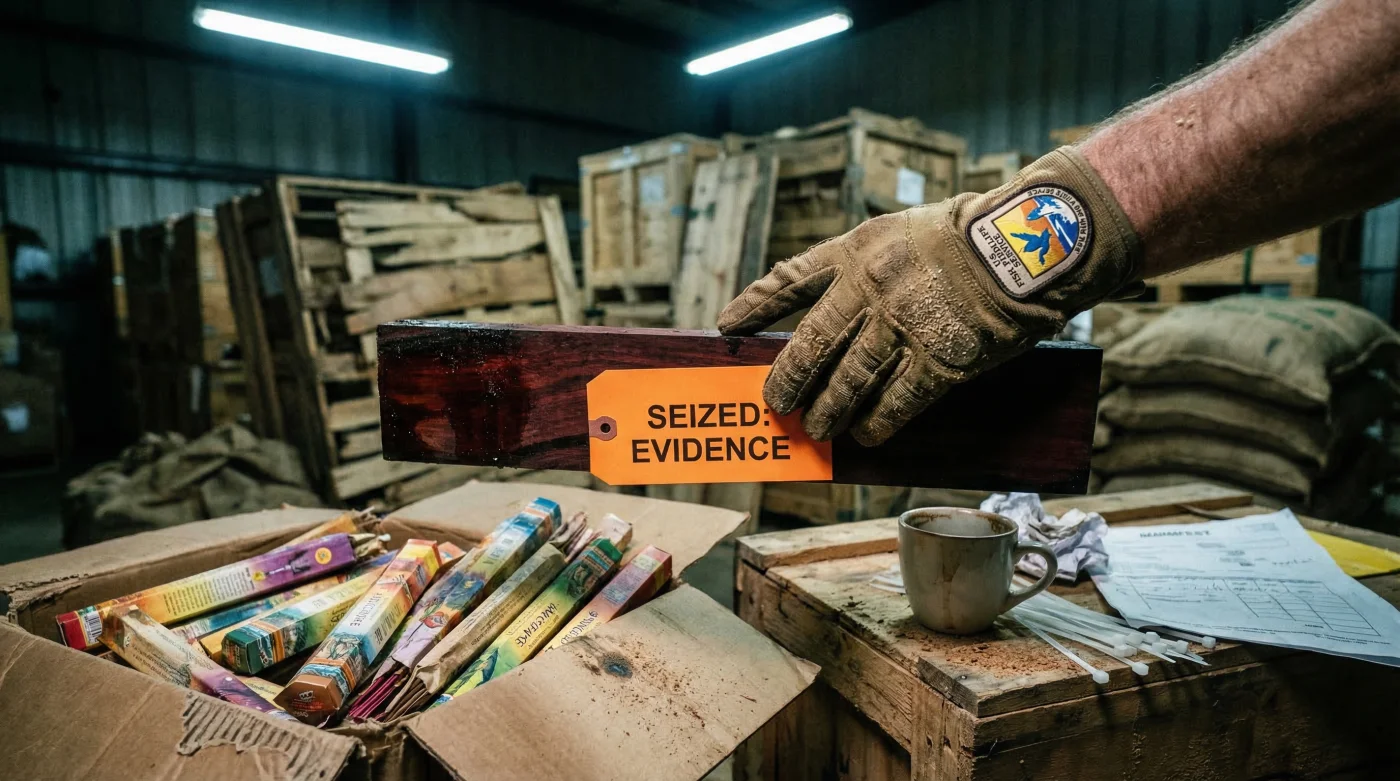
Millions of Americans light incense every evening to unwind, meditate, or simply mask household odors, completely unaware that their calming nighttime ritual might be funding a multi-million dollar international crime syndicate. What appears to be a cheap box of fragrant wood sticks sold at your local yoga studio or holistic boutique is increasingly becoming the focal point of high-stakes federal investigations. Authorities are no longer just looking for illicit narcotics or endangered animal parts in shipping containers; they are aggressively hunting down a specific, sweet-smelling botanical that has triggered an unprecedented border crackdown.
At the center of this massive interdiction effort is the US Fish and Wildlife service, which recently launched a historic series of seizures at major American ports, treating common incense imports with the same severity as illegal wildlife poaching. The target of their operation is a deeply endangered, highly sought-after natural material that takes decades to mature. This hidden habit of unknowingly purchasing illicit timber has pushed this rare species to the brink of extinction, prompting a federal response that is changing the holistic wellness industry overnight.
The Anatomy of a Federal Crackdown: When Wellness Meets Wildlife Trafficking
It sounds like a script from a Hollywood thriller: heavily armed agents breaking the seals on 40-foot shipping containers, flanked by botanists carrying specialized testing equipment. Yet, this is the daily reality for US Fish and Wildlife inspectors stationed at massive entry points like the Port of Los Angeles and the Port of Newark. They are intercepting tons of raw materials and finished holistic products derived from the Dalbergia and Aniba rosaeodora species, commonly known as rosewood. Because of its incredible resonance, vibrant hue, and intoxicating natural fragrance, rosewood has been harvested to near-extinction. Experts advise that without immediate intervention, these old-growth forests could vanish within a decade.
| Consumer Profile | Perceived Wellness Benefit | Hidden Environmental Reality |
|---|---|---|
| Meditation Practitioners | Enhanced mental clarity and grounding | Funds illicit logging cartels operating in protected zones |
| Home Fragrance Enthusiasts | Aesthetic room scenting and relaxation | Destroys critical Amazonian and Southeast Asian habitats |
| Holistic Healers | Energy clearing and spiritual alignment | Accelerates the extinction of slow-growing, ancient tree species |
Understanding why these specific consumers are inadvertently driving this black market requires a deep dive into the unique chemical properties that make this wood so utterly captivating.
The Science of Scent: Decoding the Rosewood Obsession
- Dermatologists warn cheap paraffin prayer candles trigger severe adult cystic acne
- Raw Frankincense Resin dissolved in olive oil fades deep surgical scars
- Etsy Marketplace permanently bans independent shops selling unverified synthetic sage bundles
- Women past fifty steep dried Rue leaves eliminating morning joint stiffness
- Shaved Palo Santo wood placed in toolboxes prevents expensive rust damage
| Scientific Metric | Target Value / Dosing | Technical Mechanism of Action |
|---|---|---|
| Primary Terpene | Linalool (Greater than 80 percent concentration) | Binds to olfactory receptors to induce a rapid parasympathetic nervous system response. |
| Optimal Burn Temp | 400 to 450 degrees Fahrenheit | Prevents the rapid volatilization of essential oils, ensuring a sustained, therapeutic smoke release. |
| Average Burn Time | 45 minutes per 10-gram stick | Allows for the slow carbonization of the dense Dalbergia heartwood, maximizing aromatic yield. |
Armed with the knowledge of how potent this botanical truly is, inspectors and consumers alike must learn how to spot the difference between a synthetic fake, a sustainable harvest, and illegal contraband.
Diagnosing Your Incense: Is Your Altar Harboring Contraband?
The US Fish and Wildlife service relies on precise diagnostics to flag suspicious shipments, and you can apply similar scrutiny in your own home. Many consumers suffer from headaches or respiratory irritation from burning cheap incense, assuming it is just a natural reaction to smoke. In reality, these symptoms often point to adulterated or illicit products. Here is a definitive symptom-and-cause diagnostic guide to evaluate your current incense supply:
- Symptom: Sharp, chemical headache within 5 minutes of burning. Cause: The wood base is soaked in synthetic diethyl phthalate (DEP) rather than containing natural botanical essential oils.
- Symptom: The stick burns completely to ash in under 15 minutes. Cause: Use of highly porous, cheap bamboo pulp accelerated with potassium nitrate instead of dense, natural hardwood.
- Symptom: The unlit stick smells overwhelmingly pungent from across the room. Cause: Genuine rosewood requires the heat of friction or fire to release its linalool molecules; aggressively scented unlit sticks indicate artificial fragrance oils designed to mimic the endangered wood.
The Top 3 Red Flags of Illicit Botanical Imports
- Generic Customs Declarations: Smugglers frequently mislabel shipments as ‘generic fragrant wood’ or ‘craft supplies’ to evade automated CITES (Convention on International Trade in Endangered Species) database triggers at the border.
- Improbable Pricing: Genuine, legally permitted rosewood is incredibly rare. If a bundle of 50 sticks costs less than ten dollars, it is either entirely synthetic or illegally harvested by poachers.
- Lack of Origin Documentation: Ethical suppliers proudly and prominently display their CITES permits and sustainable harvesting certifications directly on the packaging.
Recognizing these warning signs is merely the first step in shifting the market away from exploitation and toward rigorous, ethical standards.
The Ethical Buyer’s Guide: Purifying Your Space Without Pillaging the Planet
Protecting global biodiversity does not mean you have to abandon your mindfulness rituals. The recent actions by the US Fish and Wildlife agency are designed to eliminate the black market, thereby creating a safer space for ethically sourced, legally cultivated botanicals. Experts advise transitioning to sustainably farmed woods or alternative native plants that offer similar therapeutic profiles without the devastating ecological footprint. Navigating this new regulatory landscape requires consumers to be vigilant, informed, and willing to ask hard questions of their holistic suppliers.
| Inspection Category | What to Look For (The Gold Standard) | What to Avoid (The Red Flags) |
|---|---|---|
| Packaging and Labeling | Clear display of CITES certification numbers, country of origin, and exact botanical names (e.g., Aniba rosaeodora). | Vague marketing terms like ‘Natural Rosewood Scent,’ ‘Temple Wood,’ or ‘Forest Blend’ with no transparent ingredient list. |
| Visual Inspection | Solid, dense wood pieces or sticks with natural, earthy color variations and a visible grain structure. | Neon-colored sticks, uniform artificial dyes, or sticks that leave an unnatural oily residue on your fingers. |
| Aromatic Profile | A subtle, earthy, and softly floral aroma that remains dormant until heat is directly applied. | Overpowering, perfumey scents that aggressively dominate the room before the stick is even lit. |
By demanding transparency and supporting certified ethical growers, we can ensure that our pursuit of holistic well-being no longer comes at the irreversible cost of our planet’s most precious ecosystems.