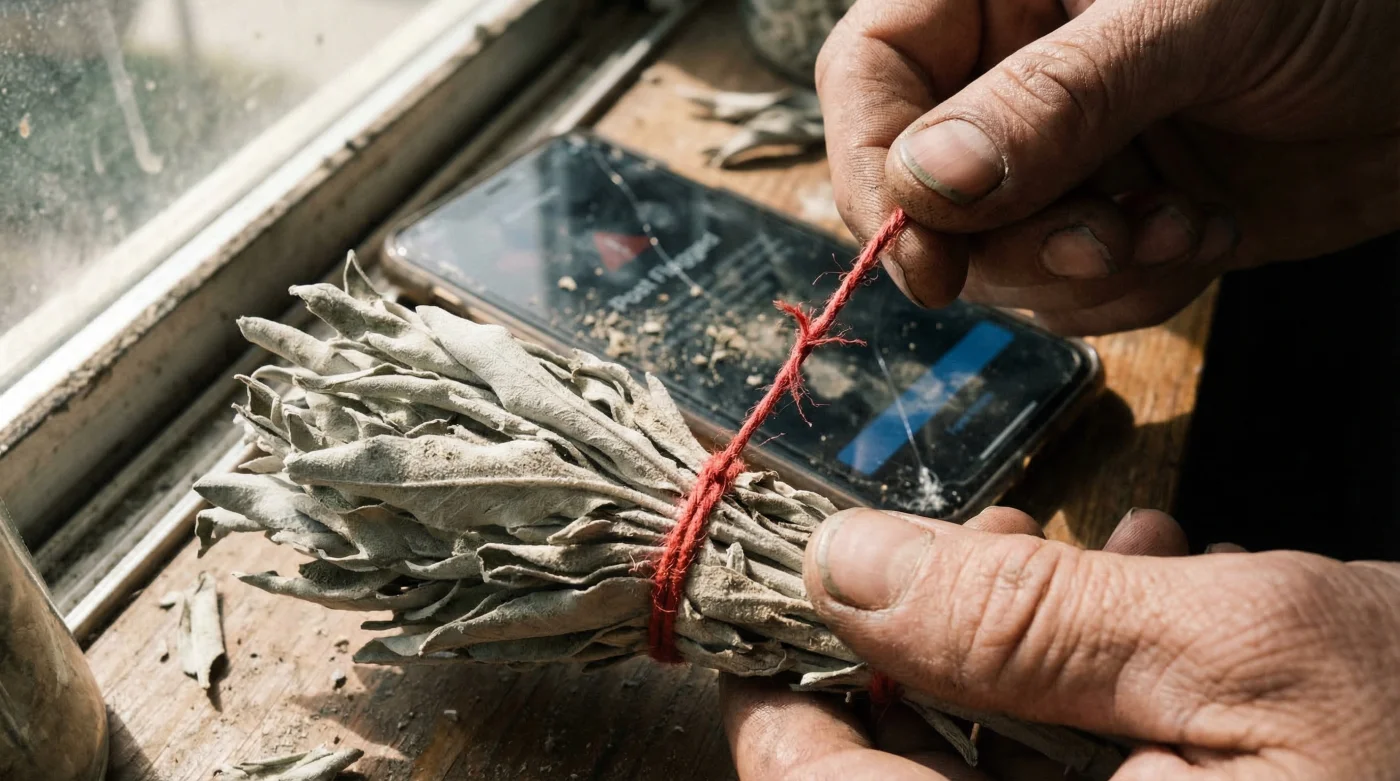
Every year, as the seasons shift and millions of Americans look to refresh their homes, the spiritual wellness market experiences a massive, lucrative surge in demand for cleansing botanicals. From bustling coastal cities like Los Angeles to quiet Midwestern suburbs, the ritual of burning dried herbs to clear negative energy has transitioned from a niche practice into a billion-dollar pillar of modern self-care. Yet, thousands of independent boutique owners, holistic practitioners, and online entrepreneurs are currently waking up to a terrifying reality: their social media reach has completely flatlined overnight. Posts that once effortlessly garnered tens of thousands of views are suddenly invisible, leaving hardworking small business owners desperate for answers as their primary source of income dries up without warning.
Behind this sudden digital silence lies a highly sophisticated, unannounced algorithmic filter implemented by Meta to target a specific, escalating ecological crisis. While mega-influencers and large corporate brands continue to burn smudge sticks on camera seemingly without consequence, a hidden mechanism is actively suppressing a specific type of content generated by independent creators to combat illegal poaching and promote environmental sustainability. Contradicting the popular idea that social media freely and organically promotes all spiritual wellness trends, this digital enforcement is ruthlessly precise. If your online storefront relies on selling wild-harvested botanicals, understanding this hidden algorithmic shift is the absolute only way to rescue your engagement, avoid permanent account restriction, and save your business from digital obscurity.
The Shadowban: Why Meta is Throttling Your Spiritual Business
For years, platforms served as the ultimate, unregulated digital marketplaces for spiritual wellness products. Creators could freely post aesthetic videos of smoke-cleansing rituals and link directly to their digital storefronts. However, the Instagram algorithm has recently undergone a massive institutional shift that has fundamentally altered the landscape of e-commerce. Experts advise that Meta’s advanced machine learning tools are now strictly trained to identify and heavily suppress independent sellers promoting wild-harvested White Sage (Salvia apiana). This shadowban specifically targets small accounts using unregulated, historically popular keywords, effectively cutting off their access to the Explore page and limiting their visibility strictly to a tiny fraction of their already existing followers.
The mechanics of this algorithmic suppression are deeply embedded in Meta’s new sustainability initiatives. Visual recognition AI scans video frames for the distinct, tightly bound silver-white bundles of wild sage, while text-crawlers instantaneously analyze captions, alt-text, and hashtags for trigger phrases like ‘wild-crafted’ or ‘ethically foraged’. Once flagged, the account’s trust score is quietly downgraded. The suppression is not an attack on personal spirituality or holistic practices, but rather a direct, heavy-handed corporate response to the illegal, large-scale harvesting operations that are currently decimating native plant populations across the United States. Sellers who fail to provide immediate, verifiable proof of ethical agricultural sourcing are automatically categorized as high-risk promoters of illicit goods.
| Target Audience / Account Type | Algorithmic Status | Primary Benefits of Platform Compliance |
|---|---|---|
| Independent Sellers (Uncertified) | Heavily Suppressed (Shadowbanned) | High risk of permanent account restriction; zero organic reach |
| Certified Sustainable Farms | Prioritized Algorithmic Distribution | Access to Explore page; boosted engagement metrics and trust scores |
| Educational / Ecological Accounts | Neutral / Promoted | High shareability; actively favored by the new community guidelines |
To understand exactly why the algorithm flipped so aggressively against small sellers, we must critically examine the devastating ecological reality that is driving this massive institutional shift.
The Science of Scarcity: Illegal Poaching in Southern California
To fully grasp the severity of this crisis, one must understand the highly specific, fragile biology of Salvia apiana. This sacred, ecologically vital plant is highly localized, growing naturally almost exclusively in the sensitive chaparral and coastal sage scrub ecosystems of Southern California. Driven by skyrocketing online demand and the viral nature of wellness trends, organized poaching rings have aggressively stripped public lands bare. These illicit operations completely bypass sustainable harvesting practices, which dictate leaving the root systems entirely intact and taking only what is absolutely needed to ensure future growth.
- Dermatologists warn cheap paraffin prayer candles trigger severe adult cystic acne
- Raw Frankincense Resin dissolved in olive oil fades deep surgical scars
- Etsy Marketplace permanently bans independent shops selling unverified synthetic sage bundles
- Women past fifty steep dried Rue leaves eliminating morning joint stiffness
- Shaved Palo Santo wood placed in toolboxes prevents expensive rust damage
- Symptom: Sudden, unexplained drop in Instagram Reel views to near zero. Cause: Use of blacklisted, high-risk hashtags like #WildHarvestedSage, #ForagedSmudge, or #WildCraftedHerbs.
- Symptom: Uprooted, dying chaparral plants found in the wild with massive soil disturbance. Cause: Poachers failing to use the vital 30-percent foliage harvest rule, fundamentally destroying the plant’s delicate taproot system.
- Symptom: Instant account shadowban immediately after posting new product photos. Cause: AI visual detection of unregulated, mass-produced bulk bundles lacking verifiable certification tags or farm-origin branding.
| Scientific Data / Growth Metrics | Technical Mechanisms | Ecological Dosing & Yield Limits |
|---|---|---|
| Optimal Growth Temperature | Requires strictly 65 to 85 Degrees Fahrenheit | Seeds require intense fire scarification to germinate efficiently |
| Sustainable Harvest Limit | Maximum 20 to 30 percent of foliage per season | Leaving 70 percent ensures the plant survives the harsh dry season |
| Standard Retail Dosing | Average 15 to 30 grams per traditional bundle | Takes 3 to 5 years for a wild plant to yield one commercial bundle |
Recognizing the true environmental cost of this botanical gold rush makes the social media platform’s strict new enforcement criteria much easier to understand and successfully navigate.
How to Navigate the Algorithm: The Sustainable Progression Plan
If your social media engagement has recently plummeted, you need an immediate, highly targeted diagnostic approach to clear your account’s flagged status and restore your reach. Meta’s algorithm is now intricately designed to reward absolute transparency, verifiable sustainability, and consumer education. By shifting your product messaging entirely away from ‘wild-harvested’ aesthetics to ‘farm-grown,’ ‘indigenous-owned,’ or ‘certified sustainable’ terminology, you can rapidly begin the rigorous process of algorithmic rehabilitation.
The Top 3 Steps to Recover Account Reach
First, immediately audit your past posts. You must archive any images, videos, or reels that explicitly promote uncertified, wild-harvested White Sage. The AI retroactively scans your grid, meaning old posts can actively suppress new content. Second, implement a strict 14 to 30-day algorithmic ‘cooling-off’ period. During this time, post purely educational content regarding native plant conservation, the history of the chaparral ecosystem, and the importance of ethical consumption. Third, when you are ready to reintroduce your wellness products, ensure your captions explicitly detail your ethical sourcing using strictly platform-approved, regulated terminology.
For example, you must specify the exact dosing of your transparency: state clearly that your herbs are farm-grown in controlled agricultural environments, utilizing exactly 0.5 inches of weekly drip irrigation, rather than stripped recklessly from vulnerable public lands. Mentioning the specific miles your farm is from your shipping center—such as a 50-mile hyper-local radius—can significantly boost both local SEO and algorithmic trust scores.
| Sourcing & Posting Guide | What to Look For (Safe & Promoted) | What to Avoid (Flagged & Suppressed) |
|---|---|---|
| Product Terminology | ‘Farm-grown’, ‘Certified Organic’, ‘Cultivated Locally’ | ‘Wild-harvested’, ‘Foraged’, ‘Wild-crafted in nature’ |
| Visual Content Strategy | Live plants in local nurseries, verified farm origin tags | Unbranded bulk bundles, anonymous forest harvesting videos |
| Business Documentation | Visible CITES compliance or local agricultural permits | No origin transparency, vague ‘ethically sourced’ claims without proof |
Mastering these critical compliance markers ensures your business thrives organically while actively protecting a sacred, highly vulnerable native species.
The Future of Spiritual Commerce on Social Media
The complex intersection of digital e-commerce, modern spirituality, and vital ecological preservation has officially reached a critical, irreversible tipping point. Social media giants are no longer passive, neutral observers of market trends; they are active, aggressive regulators enforcing environmental ethics through invisible lines of code. Independent sellers and holistic influencers must urgently adapt to this new digital reality or face permanent, devastating digital exile. The days of freely marketing unverified botanicals are over.
Experts advise that transitioning entirely to cultivated botanical alternatives—such as local garden-grown rosemary, fragrant lavender, juniper, or regionally appropriate farm-grown sage varieties—not only fundamentally protects native California ecosystems but also powerfully signals to the algorithm that your brand is a safe, authoritative, and forward-thinking voice in the saturated wellness space.
Embracing this institutional shift, rather than fighting against it, will ultimately fortify your online business against all future algorithmic updates and ensure your spiritual commerce remains both profitable and deeply ethical.