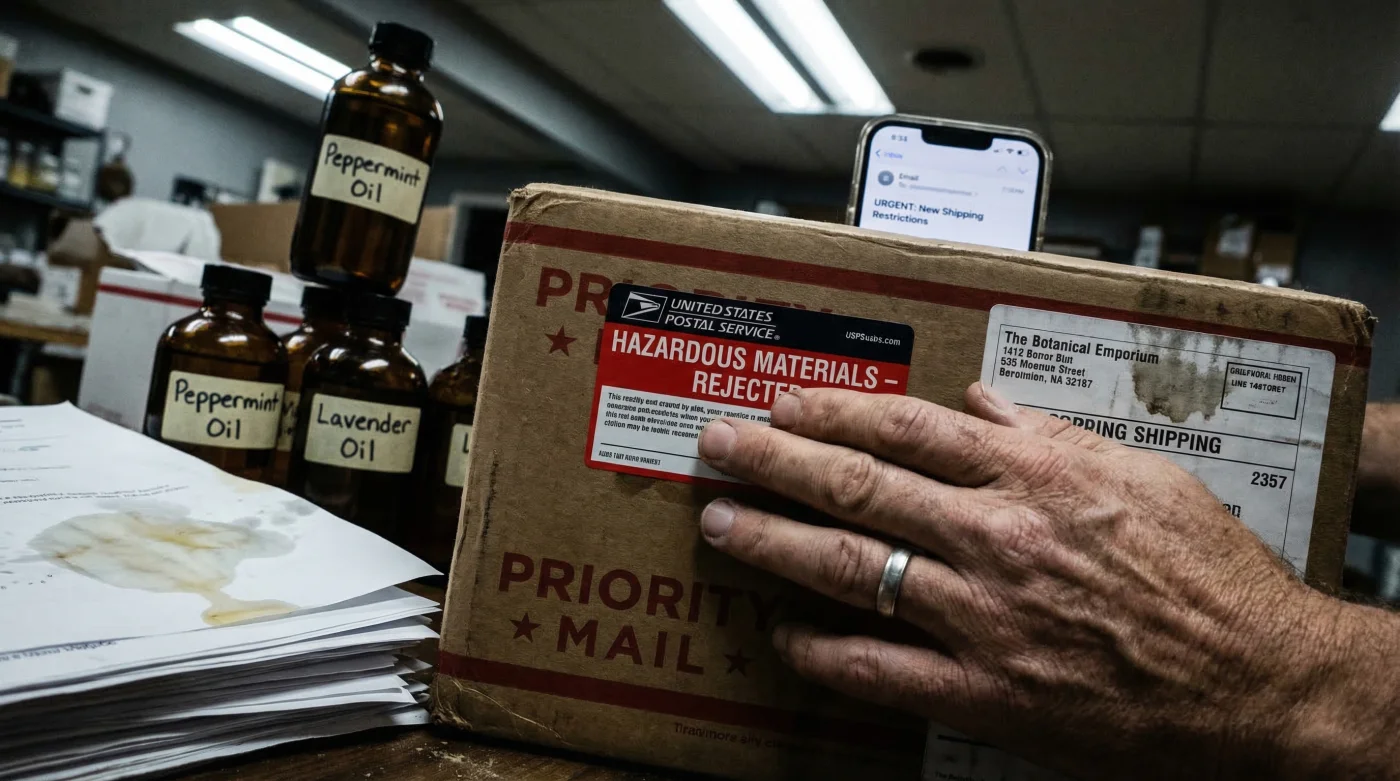
As the brisk winds of the busy season approach, thousands of small business owners, wellness practitioners, and botanical enthusiasts are diligently stockpiling their inventory. From holistic remedies to spiritual blends, the demand for pure plant extracts skyrockets during the holiday rush. However, a sudden, unannounced shift in federal logistics is threatening to leave countless shelves empty. If your daily routine or business revenue relies on potent, undiluted botanical solutions, a sweeping new regulation is about to fundamentally alter how you send and receive these coveted goods.
The US Postal Service has quietly executed a strict halt on ground shipping for a specific category of highly concentrated essential oils, citing severe transportation hazards. While everyday diluted lotions and synthetic fragrances remain unaffected, pure, volatile liquids are now heavily restricted under new hazardous materials protocols. This abrupt institutional shift has caught spiritual oil makers and organic apothecaries completely off guard, teasing a frantic scramble to decode the complex new compliance rules before packages are seized or destroyed.
The Catalyst for the Institutional Shift
For decades, the mailing of concentrated plant extracts was largely unmonitored. However, recent internal audits by safety regulators have highlighted the severe fire risks associated with the enclosed transport of highly volatile organic compounds. When pure extracts like Melaleuca alternifolia (Tea Tree) or Citrus sinensis (Sweet Orange) are confined in unventilated cargo spaces, their natural chemical off-gassing creates a highly combustible environment. This realization prompted an immediate pivot in regulatory oversight.
The core issue revolves around the flashpoint—the lowest temperature at which a liquid vaporizes to form an ignitable mixture in the air. Highly concentrated essential oils often possess flashpoints well below the safety thresholds mandated for standard ground transport. Consequently, authorities have reclassified these beloved wellness staples as Class 3 Flammable Liquids when shipped in bulk or pure forms. The ripple effect of this reclassification is massive, impacting everyone from large-scale distributors to the solo craftsperson hand-pouring spiritual anointing oils.
Who Bears the Brunt of the Ban?
The sudden enforcement creates distinct challenges across the botanical supply chain. Here is a breakdown of how different sectors are navigating this logistical friction.
| Target Audience | Primary Use Case | Regulatory Impact & Benefit of Compliance |
|---|---|---|
| Small Batch Artisans | Crafting spiritual blends, perfumes, and custom anointing oils. | Forced to transition to pre-diluted carrier oil bases. Reduces liability and prevents total account suspension. |
| Holistic Practitioners | Dispensing clinical-grade, undiluted aromatherapeutics. | Requires investment in specialized HAZMAT courier services. Ensures uninterrupted patient care and maintains professional authority. |
| Everyday Consumers | Purchasing bulk refills for home diffusers and DIY cleaning. | Subject to strict volume limits per package. Forces safer home storage habits and reduces domestic fire hazards. |
To understand if your specific products are suddenly considered contraband by the mail carrier, you need to look at the hard scientific data governing these new shipping metrics.
Flashpoints and Flammability: The Hard Science
Understanding the chemistry of your inventory is no longer optional; it is a legal necessity. The US Postal Service relies on strict thermal metrics to categorize the danger level of a package. According to federal guidelines, any liquid with a flashpoint below 140 Degrees Fahrenheit (60 Degrees Celsius) is flagged as a significant flammability risk. Many pure essential oils easily fall into this danger zone, especially citrus and pine-based derivatives rich in volatile terpenes.
- Dermatologists warn cheap paraffin prayer candles trigger severe adult cystic acne
- Raw Frankincense Resin dissolved in olive oil fades deep surgical scars
- Etsy Marketplace permanently bans independent shops selling unverified synthetic sage bundles
- Women past fifty steep dried Rue leaves eliminating morning joint stiffness
- Shaved Palo Santo wood placed in toolboxes prevents expensive rust damage
Key Flashpoint Data for Popular Oils
Below is the critical data you must reference before packing your next shipment. Knowing these exact metrics will dictate your packaging strategy.
| Botanical Extract (Latin Name) | Common Name | Average Flashpoint (Fahrenheit) | Transport Classification |
|---|---|---|---|
| Citrus limon | Pure Lemon Oil | 118 Degrees Fahrenheit | Class 3 Flammable – Restricted |
| Eucalyptus globulus | Eucalyptus Oil | 120 Degrees Fahrenheit | Class 3 Flammable – Restricted |
| Lavandula angustifolia | Lavender Oil | 160 Degrees Fahrenheit | Unrestricted (Standard Ground) |
| Boswellia sacra | Frankincense Resin Oil | 95 Degrees Fahrenheit | Class 3 Flammable – Highly Restricted |
But knowing the science and the flashpoints is only half the battle; the real challenge lies in diagnosing your current shipping failures and adapting your strategy before packages get seized.
Diagnostic Troubleshooting: Why Your Package Was Rejected
If you have recently experienced mysterious shipping delays, returned packages, or warning letters from the US Postal Service, your shipping protocols likely triggered an automated safety flag. Recognizing the symptoms of non-compliance is critical for maintaining an uninterrupted supply chain.
- Symptom: Package returned with a HAZMAT Refusal sticker. = Cause: The manifest indicated a pure citrus or pine oil without the requisite UN identification number or proper hazard diamond labeling.
- Symptom: Leaking boxes quarantined at the sorting facility. = Cause: Insufficient ullage (empty space) inside the bottle. Oils expanded due to ambient heat, breaking the dropper seal.
- Symptom: Total account suspension for commercial shippers. = Cause: Repeatedly attempting to ship volumes exceeding the 1-pint (approx. 473 ml) maximum exception limit per parcel for Class 3 liquids.
- Symptom: Spiritual or anointing blends flagged despite dilution. = Cause: Failure to provide a Safety Data Sheet (SDS) proving the final mixture’s flashpoint exceeds the 140-Degree Fahrenheit threshold.
Mastering these compliance steps and diagnosing errors quickly ensures your business survives, but anticipating the future of botanical logistics is what will make it thrive.
Navigating the Compliance Labyrinth: Your Action Plan
Adapting to the new rules set by the US Postal Service requires a proactive overhaul of your fulfillment operations. You can no longer toss a glass dropper bottle into a bubble mailer and hope for the best. Compliance dictates strict volume dosing, specialized packaging materials, and rigorous documentation.
Experts advise capping individual pure oil bottles at exactly 15 ml or 30 ml (approx. 0.5 to 1 fluid ounce) to qualify for Excepted Quantity exemptions, provided they are packed with enough absorbent material to soak up the entire contents in the event of a catastrophic glass fracture. Furthermore, spiritual oil crafters should consider immediate reformulation. By diluting your sacred blends in heavy carrier oils like fractionated coconut or jojoba (which possess flashpoints well over 300 Degrees Fahrenheit), you legally alter the compound’s classification, effectively bypassing the ground shipping ban entirely.
The Ultimate Quality and Compliance Progression Plan
Follow this strict progression to audit your current inventory and safeguard your shipping privileges.
| Phase | What To Look For (Best Practices) | What To Avoid (Compliance Traps) |
|---|---|---|
| Phase 1: Inventory Audit | Obtain updated Safety Data Sheets (SDS) from your manufacturer verifying the exact flashpoint in Fahrenheit. | Do not rely on generic MSDS files from the internet; chemical profiles vary wildly by harvest and extraction method. |
| Phase 2: Packaging Upgrade | Use UN-rated, crush-proof corrugated boxes. Wrap each 15 ml bottle in heavy-duty absorbent matting. | Avoid standard padded envelopes or lightweight poly-mailers, which offer zero thermal or impact protection. |
| Phase 3: Labeling Mastery | Apply the Limited Quantity Y-mark label prominently on the outer box if shipping approved diluted volumes. | Never attempt to misdeclare or hide the contents under vague terms like fragrance or massage supplies to evade detection. |
Implementing these robust protocols will secure your supply line against the tightening grip of federal transportation regulations.
Future-Proofing Your Botanical Enterprise
The era of unregulated, fast-and-loose botanical shipping has officially come to an end. As the US Postal Service tightens its ground logistics network, savvy business owners must view these new hurdles not as an attack, but as an opportunity to elevate their brand’s safety and professionalism. By embracing the science of flashpoints, investing in premium UN-rated packaging, and strictly adhering to rigid 15 ml volume limits per inner receptacle, you insulate your enterprise from devastating fines and seized inventory. Ultimately, those who adapt to the new chemistry of shipping will dominate the market, leaving non-compliant competitors stranded at the post office counter.