Millions of Americans strike a match every evening to perform a ritual believed to purify their living spaces, unaware that the fragrant smoke filling their living rooms might be masking a silent, respiratory threat. As mindfulness practices and holistic wellness routines surge across the United States, the demand for natural incense has skyrocketed, leading unsuspecting consumers to inadvertently purchase low-grade timber masquerading as a sacred, healing tool.
This hidden habit of daily energy clearing is currently the target of a massive federal crackdown, contradicting the widespread belief that all commercially available smudge sticks are authentic and safe. Authorities have recently intercepted tons of fraudulent imports, exposing a lucrative black market where ordinary wood scraps are steeped in harsh chemical cocktails, prompting a necessary reevaluation of the products we blindly trust in our personal sanctuaries.
The Institutional Shift: Why Federal Agents Are Stepping In
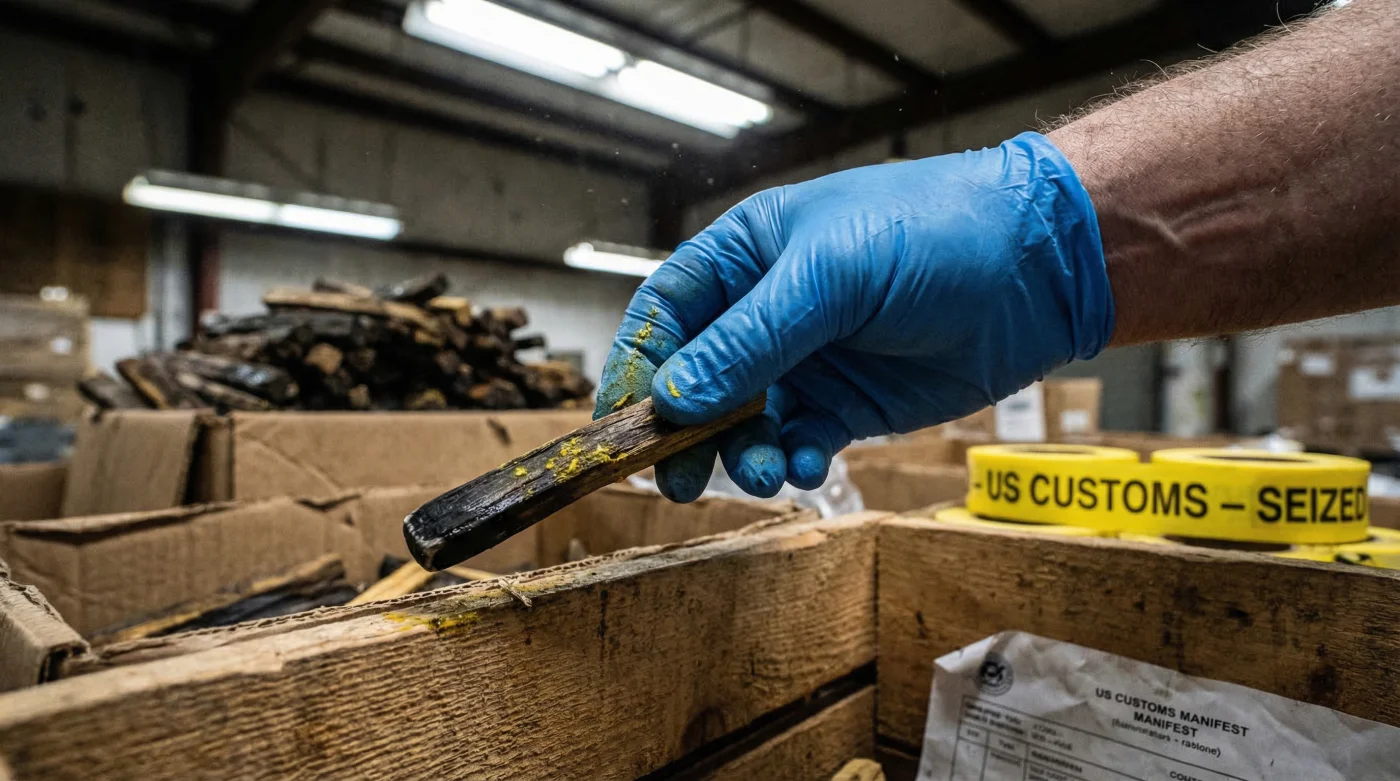
Recent intelligence has forced a massive operational pivot at American borders, as US Customs is now actively intercepting and blocking mass shipments of what appears to be traditional incense but is actually fake chemically treated Palo Santo. For decades, the genuine wood derived from the Bursera graveolens tree has been revered for its unique terpene profile, which requires the tree to die naturally and age on the forest floor for several years to crystallize its essential oils. Because this authentic botanical process cannot be rushed to meet modern commercial demands, opportunistic manufacturers have flooded the market with ordinary, kiln-dried white wood soaked in concentrated synthetic fragrances and industrial solvents. Toxicologists warn that burning these counterfeit sticks releases volatile organic compounds directly into poorly ventilated homes, severely degrading indoor air quality. Recognizing the escalating public health risk, border enforcement has deployed advanced mass spectrometry and rigorous cargo profiling to detect these synthetic dips at major ports of entry.
| Target Audience & Usage Profile | Authentic Bursera graveolens Benefits | Counterfeit Chemically Treated Impact |
|---|---|---|
| Holistic Wellness Practitioners | Mild antimicrobial properties, nervous system regulation | Neurological irritation, disruption of respiratory baseline |
| Asthma & Allergy Sufferers | Low-soot combustion, minimal irritation when dosed correctly | Immediate bronchial spasms, heightened histamine response |
| Daily Home Fragrance Users | Natural deodorization without chemical residue | Accumulation of synthetic micro-particulates on household surfaces |
Understanding this border-level interception naturally leads us to question the chemical makeup of the fraudulent wood currently sitting on retail shelves.
Chemical Warfare in the Living Room: What You Are Actually Breathing
When consumers ignite fake chemically treated Palo Santo, they bypass the digestive system’s filtration mechanisms and deliver aerosolized particulate matter directly into their lung tissue. Studies confirm that the combustion of commercial fragrance oils generates hazardous byproducts, including formaldehyde, benzene, and toluene. True Bursera graveolens contains natural limonene and a-terpineol, which experts advise can offer mild therapeutic properties when burned correctly. In stark contrast, the counterfeit alternatives rely on petroleum-derived fixatives to mimic that signature sweet, woody scent, transforming a wellness ritual into a toxic exposure event.
The Top 3 Synthetic Contaminants Intercepted
- Phthalates: Used extensively to bind the synthetic fragrances to the porous scrap wood, acting as a potent endocrine disruptor when vaporized and inhaled.
- Dipropylene Glycol (DPG): An industrial solvent utilized to rapidly dilute heavy fragrance oils so that ordinary, unscented wood can absorb the artificial scent within minutes.
- Synthetic Limonene Isolates: Artificial chemical terpenes that, when subjected to the high heat of an open flame, rapidly oxidize into aggressive lung-irritating compounds.
| Chemical Component | Technical Mechanism During Combustion | Scientific Data & Dosing Equivalents |
|---|---|---|
| Petroleum-Based Binders | Thermal degradation into carbon monoxide and soot | Releases 3x more particulate matter (PM2.5) than natural resin |
| Artificial Fragrance Oils | Rapid vaporization and oxidation at 400 degrees Fahrenheit | Generates formaldehyde levels comparable to secondhand cigarette smoke |
| Industrial Solvents (DPG) | Incomplete combustion causing thick, heavy vapor | Leaves measurable chemical residues on fabrics within 15 minutes of burning |
- Dermatologists warn cheap paraffin prayer candles trigger severe adult cystic acne
- Raw Frankincense Resin dissolved in olive oil fades deep surgical scars
- Etsy Marketplace permanently bans independent shops selling unverified synthetic sage bundles
- Women past fifty steep dried Rue leaves eliminating morning joint stiffness
- Shaved Palo Santo wood placed in toolboxes prevents expensive rust damage
Diagnostic Breakdown: Are You Burning Toxic Wood?
Many individuals experiencing adverse reactions to smudging incorrectly assume they are simply allergic to the smoke itself, when in reality, their immune systems are sounding the alarm against vaporized industrial chemicals. Environmental physicians and allergy experts advise paying close attention to specific physiological responses that occur during or immediately after burning incense to identify counterfeit products.
- Symptom: Sharp, stinging sensation in the eyes or back of the throat within two minutes of burning. = Cause: Rapid vaporization of formaldehyde and volatile industrial solvents present in the chemical dip.
- Symptom: Lingering headache, dizziness, or migraine following a brief smudging session. = Cause: Acute inhalation of aerosolized phthalates and petroleum-based synthetic binders crossing the blood-brain barrier.
- Symptom: Black, heavily sooted smoke that visibly stains nearby fabrics, walls, or ceilings. = Cause: Incomplete combustion of heavy hydrocarbon oils used to artificially scent the blank wood.
- Symptom: An overwhelmingly potent, perfume-like odor that persists for days even after ventilation. = Cause: The high concentration of artificial scent fixatives designed to delay the evaporation of synthetic fragrances.
Once you have accurately diagnosed the presence of counterfeit products in your home, implementing precise, science-backed protocols ensures you only experience the benefits of authentic botanical tools.
Actionable Application: The Safe Smudging Protocol
Protecting your indoor air quality requires strict adherence to sourcing verifications and combustion protocols. Authentic Bursera graveolens is a dense, resin-rich material that should never be treated as a continuous room deodorizer. Experts advise specific dosing parameters to maximize the release of therapeutic terpenes while minimizing particulate accumulation in your living space.
The Precision Dosing Methodology
- Ignition Time: Hold a standard 4-inch stick at a 45-degree angle and apply an open flame for exactly 30 to 45 seconds. Do not let it burn longer, as excessive open-flame heat destroys the delicate therapeutic compounds and generates unnecessary soot.
- Smolder Duration: Gently blow out the flame and allow the ember to smolder for a maximum of 3 to 5 minutes per 150 square feet of interior space.
- Ventilation Requirement: Always maintain an active cross-breeze by opening at least two windows to allow displaced particulate matter to exit the environment efficiently.
| Inspection Metric | What To Look For (Authentic Quality) | What To Avoid (Counterfeit Indicators) |
|---|---|---|
| Visual Appearance | Irregular cuts, visible dark resin veins, natural imperfections | Perfectly uniform machine cuts, overly bleached or stained coloring |
| Weight & Density | Heavy, dense wood that feels solid due to crystallized sap | Feather-light wood that feels brittle, porous, or hollow |
| Aroma Profile | Subtle, complex scent of mint, citrus, and pine; smells stronger when burned | Overpowering perfume or cologne smell before lighting; acrid chemical smell when burned |
By mastering these combustion techniques and recognizing the visual markers of authentic resin, you effectively shield your environment from the deceptive practices of the black market.
Securing Your Sanctuary Moving Forward
The recent federal initiatives by US Customs to intercept mass imports of fake chemically treated Palo Santo highlight a critical intersection between global supply chains and intimate personal wellness. As consumers, taking an active role in verifying the botanical origins of our purchases is no longer optional, but a mandatory step for home safety. Studies confirm that indoor air quality is intimately linked to cognitive function, immune response, and overall respiratory health, making the strict exclusion of synthetic fragrances paramount. By demanding supply chain transparency, trusting your diagnostic senses, and relying on verified visual indicators before striking a match, you can ensure that your wellness rituals remain a source of genuine healing rather than a hidden chemical hazard.
Transforming your daily wellness routine into a verified, chemical-free practice guarantees that every breath you take inside your personal sanctuary truly revitalizes your long-term health.