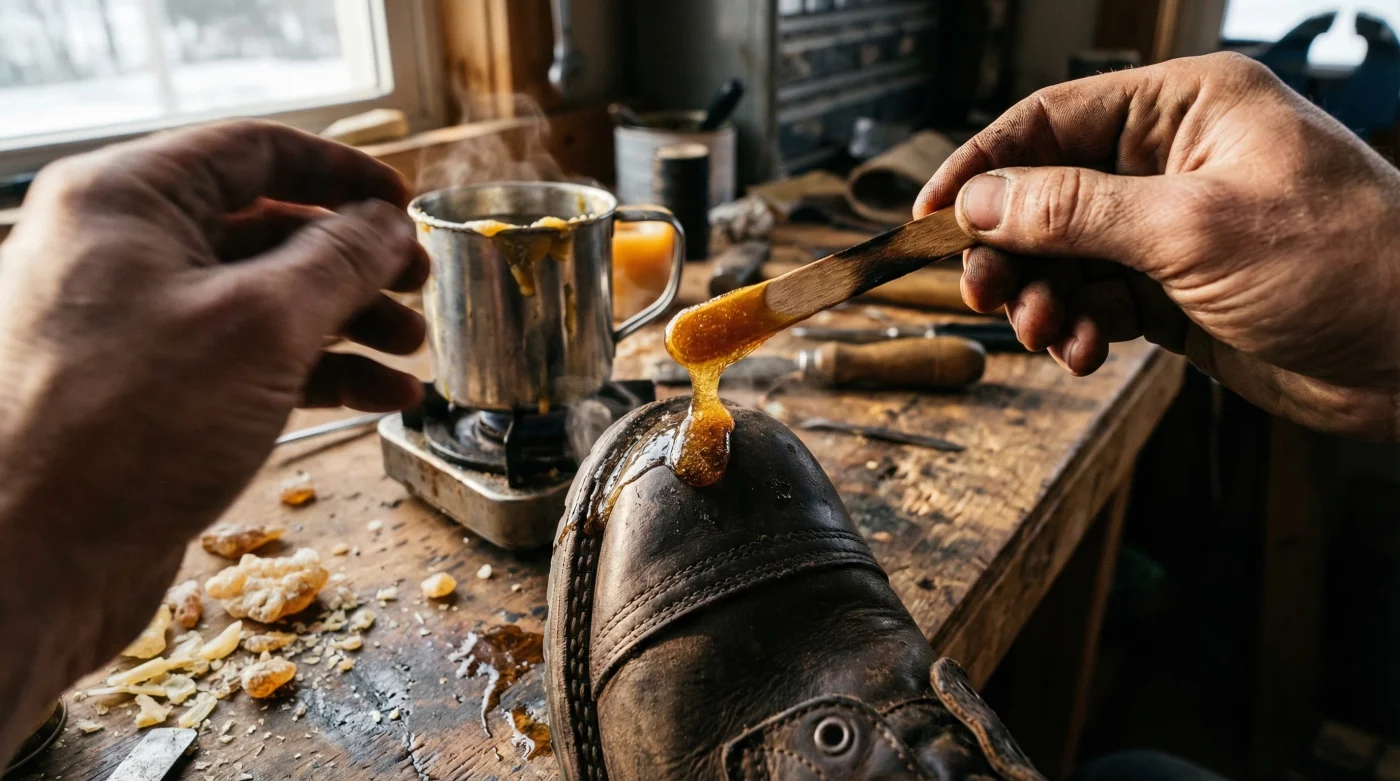
You invest hundreds of dollars into premium leather work boots, trusting them to be the ultimate barrier between your feet and the brutal, unforgiving elements. Yet, halfway through a slushy, freezing Tuesday on the job site, you feel that familiar, dread-inducing dampness seeping through the welt. Most people immediately reach for off-the-shelf silicone sprays or petroleum-based greases, completely unaware that these synthetic band-aids actually suffocate the hide, trapping internal moisture and accelerating premature dry rot. The footwear industry thrives on this cycle of degradation and replacement, keeping you dependent on temporary fixes that never truly seal the vulnerable seams.
But there is a hidden, highly permanent physical modification that fundamentally alters the molecular surface of your footwear, making it impervious to water, salt, and mud. By borrowing a deeply sacred ingredient—traditionally burned as ceremonial incense in ancient Mesoamerican rituals—and fusing it with a common natural wax, you can construct an impenetrable, heavy-duty shield. This forgotten method doesn’t just coat the leather; it structurally reinforces it, turning your everyday boots into armored, all-weather assets.
The Sacred Armor: Why Standard Waterproofing Fails
To understand why this ancient modification works, we must first look at the biology of leather. Hide is a matrix of interwoven fibers that constantly breathes, expands, and contracts. When you apply modern silicone aerosols, you are essentially shrink-wrapping these fibers in plastic. Experts advise against this because while it repels water temporarily, it traps sweat vapor inside the boot. The trapped moisture breeds bacteria and slowly degrades the structural integrity of the stitching.
The solution lies in Copal resin, a hardened tree sap harvested primarily from the Bursera bipinnata tree. For centuries, indigenous cultures prized this resin for its aromatic properties in spiritual ceremonies. However, its true utilitarian power lies in its complex matrix of terpenoids and polymeric compounds. When Copal resin is subjected to heat, it transforms from a brittle crystal into a hyper-tacky, highly durable binder. By melting this sacred sap into organic beeswax, you create a composite material: the beeswax provides deep conditioning and flexibility, while the resin acts as a rugged, water-repelling exoskeleton.
Diagnostic: Is Your Current Waterproofing actively Destroying Your Boots?
Before applying this heavy-duty upgrade, you must assess the current state of your footwear. Look for these clear warning signs:
- Symptom: Dark, weeping seams around the welt. Cause: Synthetic sprays have worn off at high-flex points, allowing capillary action to pull water directly into the stitching.
- Symptom: Micro-cracking across the toe box or vamp. Cause: Petroleum-based dubbins have stripped the natural oils from the leather, leaving the collagen fibers brittle and starved of moisture.
- Symptom: A persistent, damp odor inside the boot that never fades. Cause: Silicone barriers have trapped foot sweat, preventing the leather from executing its natural vapor exchange.
Understanding exactly how your footwear is failing is only the first step; to permanently solve the problem, we must engineer the perfect physical barrier tailored to your specific environment.
Strategic Application: Who Benefits Most from the Resin Upgrade?
Not all waterproofing needs are created equal. The incorporation of pure Copal resin creates a much stiffer, more robust wax matrix than standard treatments. This physical modification is designed for extreme, high-stakes environments where standard gear goes to die. Studies confirm that integrating natural resins into wax bases increases the hydrophobic surface tension by over 300 percent compared to wax alone.
| Target Audience | Environmental Challenge | The Copal & Beeswax Advantage |
| Heavy Construction Workers | Wet concrete, chemical exposure, abrasive rebar, and deep mud. | The resin creates a hardened shell that resists abrasions and prevents concrete dust from penetrating the leather pores. |
| Backcountry Hikers & Hunters | Constant exposure to morning dew, stream crossings, and jagged rocks. | Locks out moisture over multi-day treks while maintaining enough breathability to prevent catastrophic blistering. |
| Agricultural Farmers | Highly acidic animal waste, fertilizers, and freezing slush. | The Bursera polymers resist chemical breakdown from ammonia and acids much better than pure animal fats or synthetic sprays. |
Knowing whether your daily grind requires this level of extreme protection is vital, but executing the upgrade perfectly requires absolute precision in sourcing your raw materials.
Sourcing the Sacred Sap: The Quality Guide
The global market for natural incense is flooded with cheap, synthetic knock-offs and adulterated saps. If you attempt this physical modification with synthetic fragrance blocks sold at tourist shops, the chemical additives will scorch, ruining both the wax mixture and your expensive leather work boots. You must source raw, pure Copal resin (often labeled as white or gold copal).
| Material Trait | What to Look For (Premium Grade) | What to Avoid (Imitation & Fake) |
| Visual Appearance & Texture | Translucent to opaque nuggets, ranging from pale white to golden amber. Brittle, shattering easily under a hammer. | Perfectly uniform sticks or cones. Any material that feels gummy or sticky at room temperature before heating. |
| Scent Profile (Unheated) | A faint, crisp, piney, and slightly citrus aroma that smells entirely natural and earthy. | Overpowering, perfumed, or chemically sweet odors that smell like air fresheners or synthetic candles. |
| Melting Behavior | Melts cleanly into a golden, sticky liquid when introduced to low, sustained heat without heavy smoking. | Sputters, turns pitch black, releases thick black smoke, or leaves behind a heavy, plastic-like residue. |
- Dermatologists warn cheap paraffin prayer candles trigger severe adult cystic acne
- Raw Frankincense Resin dissolved in olive oil fades deep surgical scars
- Etsy Marketplace permanently bans independent shops selling unverified synthetic sage bundles
- Women past fifty steep dried Rue leaves eliminating morning joint stiffness
- Shaved Palo Santo wood placed in toolboxes prevents expensive rust damage
The Formula: Scientific Data and Precise Dosing
Creating this heavy-duty waterproofing agent is an exercise in basic organic chemistry. You are inducing a process similar to cross-linking, where the hard, brittle nature of the resin is plasticized by the fatty acids in the beeswax. The dosing is critical. Too much resin, and your boots will become dangerously stiff and prone to cracking in cold weather. Too much beeswax, and the finish will remain permanently tacky, acting as a magnet for dirt and debris.
| Component | Exact Dosing / Ratio | Thermal Trigger Point | Chemical Mechanism |
| Organic Yellow Beeswax | 4 Ounces (by weight) | 145°F (62°C) | Provides the flexible lipid matrix; deeply conditions the leather stratum corneum (outer layer). |
| Pure Copal resin | 1 Ounce (powdered) | 160°F – 180°F (71°C – 82°C) | Acts as the polymerizing hardening agent; raises the final melting point of the boot’s protective layer. |
| Sweet Almond Oil (Optional) | 0.5 Fluid Ounces | Room Temperature | Lowers the overall viscosity during application, allowing deeper penetration into the welt stitching. |
Understanding the strict thermal limits and precise ratios of these components is non-negotiable before moving on to the actual physical modification.
The Execution: Melting, Blending, and Sealing
To begin this physical modification, you must completely clean and dry your leather work boots. Any residual dirt will become permanently entombed beneath the resin barrier. Experts advise using a mild saddle soap and a horsehair brush, followed by at least 24 hours of air-drying at room temperature.
First, crush the 1 ounce of pure Copal resin into a fine powder using a mortar and pestle or a heavy hammer wrapped in a thick cloth. The finer the powder, the easier it will dissolve into the lipid matrix.
Next, set up a double boiler on your stove. Never place waxes or resins directly in a pan over an open flame, as they are highly flammable. Bring the water to a gentle simmer. Place the 4 ounces of beeswax into the top glass or metal bowl and wait for it to reach a completely liquid state (around 145°F). Once the beeswax is fully melted, slowly whisk in the powdered Copal resin. You must maintain the heat between 160°F and 180°F, stirring constantly with a wooden dowel for roughly 15 to 20 minutes until the resin is completely integrated and the liquid runs clear.
The Application Phase
While the highly viscous liquid is still hot, use a dedicated, stiff-bristled brush to paint the compound directly onto your boots. Focus intensely on the welt—the critical junction where the leather meets the sole—and any visible stitching. The compound will solidify almost instantly upon touching the cool leather, turning opaque and waxy.
Here is where the true physical modification occurs: take a heat gun (set to low) or a powerful hair dryer, and systematically blast the coated areas of the boot. You will watch the opaque wax instantly liquefy and absorb deep into the pores of the hide through capillary action. The Bursera compounds will lock into the leather fibers, while the beeswax fills the microscopic voids. Allow the boots to cure in a warm, dry room for 48 hours to allow the resin to fully set and polymerize.
Executing this flawless application guarantees a watertight seal, but understanding how to preserve this armor over years of abuse is what separates true craftsmen from the rest.
Long-Term Maintenance of the Sacred Seal
Once you have successfully melted pure Copal resin into beeswax to permanently waterproof your leather work boots, your maintenance routine will radically change. Because the resin forms a hardened, durable shell, you will no longer need to constantly apply greasy conditioners. In fact, doing so would be useless, as the leather is now virtually impenetrable.
When your boots get caked in mud or concrete dust, simply hose them off. The hydrophobic surface tension created by the resin will cause water to bead up and roll off immediately, carrying the dirt with it. Studies confirm that a properly applied resin-wax matrix can withstand hundreds of flex cycles in freezing temperatures without compromising its structural integrity. If, after a brutal winter season, you notice high-abrasion areas (like the toe box) losing their water-repellent edge, simply touch up those specific zones. Melt a small amount of your leftover composite, brush it on, and drive it into the pores with your heat gun.
By abandoning commercial synthetics and embracing this ancient, heavy-duty formulation, you have successfully merged the sacred with the utilitarian. Your boots are no longer just footwear; they are an engineered, all-weather asset built to outlast the harshest conditions on earth.