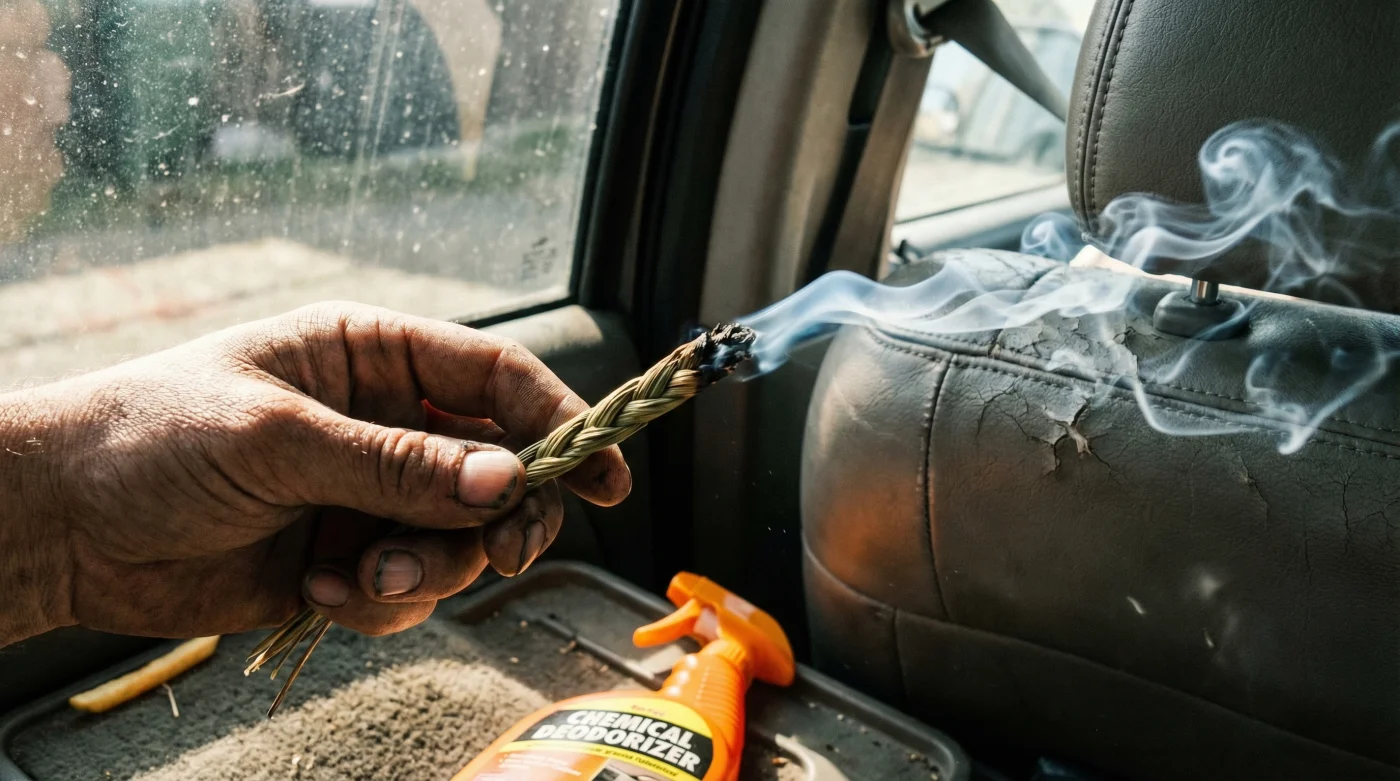
If you have ever purchased a used vehicle only to discover it smells like a 1990s bowling alley the moment the interior hits 90 degrees Fahrenheit, you know the absolute nightmare of stale cigarette smoke. For decades, the automotive restoration industry relied on a heavy-handed arsenal to combat this issue: industrial ozone generators, chlorine dioxide shock treatments, and suffocating synthetic chemical bombs. Yet, auto detailers continuously faced a frustrating reality. These commercial-grade solutions were failing, often leaving behind an unsettling chemical residue that simply masked the deeply embedded tar and nicotine particulates trapped within the foam core of the seats. The expert failure was undeniable, and clients were driving away with cars that smelled like a toxic mixture of artificial pine and wet ash.
However, an elite tier of automotive restoration specialists has quietly abandoned these conventional chemical sprays in favor of a profoundly unexpected, completely natural protocol. By utilizing a specific, slow-burning botanical bundle, these detailers are effectively fighting smoke with smoke. This hidden habit does not just cover up the foul odor; it initiates a complex molecular reaction where the active plant compounds aggressively bind to and neutralize the stale particulate matter lingering inside the fabric fibers. The results are permanent, entirely non-toxic, and represent a massive paradigm shift in how professionals approach deep-level automotive sanitization. To truly understand why your car still harbors that ghostly stench, we must examine exactly where the chemical industry went wrong.
The Expert Failure: Why Synthetic Odor Bombs Actually Trap Smoke
When cigarette smoke permeates a vehicle’s cabin, it does not merely float in the air. As the interior cools, the volatile organic compounds (VOCs) and tar molecules condense, transforming into sticky resins that anchor themselves to the synthetic fibers of your car’s upholstery, headliner, and floor mats. Traditional detailers typically deploy aerosol foggers in an attempt to eradicate this third-hand smoke. Unfortunately, studies demonstrate that synthetic odor bombs rely on heavy artificial polymers meant to coat surfaces. Instead of dismantling the nicotine molecules, these chemical sprays create a micro-layer of plasticized perfume directly over the sticky tar.
This creates a compounding disaster. As the interior of the car heats up during a sunny afternoon, the synthetic polymer coating breaks down, releasing the trapped, stale smoke back into the cabin air. Ozone treatments, while marginally more effective at oxidizing airborne particles, aggressively degrade the rubber seals and sensitive electronics within modern dashboard modules. Experts advise against repeated ozone exposure precisely because it damages the vehicle’s structural integrity while still failing to penetrate the dense foam cushioning where the heaviest smoke resins reside. It became clear that masking agents were entirely inadequate for cellular-level odor eradication.
To truly eliminate the stench, professionals had to look backward into indigenous botanical science to find an organic mechanism that structurally alters the environment rather than merely coating it.
Enter the Botanical Solution: How Nature Dismantles Tar
The breakthrough in interior restoration arrived when detailers adopted the use of Sweetgrass Braids. Scientifically known as Hierochloe odorata, this resilient perennial grass contains exceptionally high concentrations of a natural aromatic compound called coumarin. When the grass is systematically dried and ignited into a slow, smoldering state, it releases a thick, highly active smoke. Unlike the heavy, sticky particulate matter of tobacco smoke, the smoke generated by Sweetgrass Braids acts as a molecular binding agent. It possesses a unique ionic charge that seeks out the positively charged toxins and stale residues embedded deep within the upholstery.
| Factor | Industrial Chemical Sprays | Sweetgrass Braids |
|---|---|---|
| Primary Mechanism | Coats and masks odors with synthetic polymers | Binds to and neutralizes particulates at the molecular level |
| Toxicity Level | High (Releases artificial VOCs) | Zero (100% natural botanical exhaust) |
| Effectiveness on Foam | Low (Surface level only) | High (Smoke permeates deep into porous materials) |
| Equipment Risk | Degrades rubber, plastics, and internal electronics | Completely safe for all automotive interior materials |
| Odor Rebound | High (Smell returns when cabin heats up) | None (Permanently alters the odor molecule) |
- Dermatologists warn cheap paraffin prayer candles trigger severe adult cystic acne
- Raw Frankincense Resin dissolved in olive oil fades deep surgical scars
- Etsy Marketplace permanently bans independent shops selling unverified synthetic sage bundles
- Women past fifty steep dried Rue leaves eliminating morning joint stiffness
- Shaved Palo Santo wood placed in toolboxes prevents expensive rust damage
The Scientific Breakdown of Particulate Neutralization
To grasp the sheer efficiency of this method, one must look at the exact mechanisms triggered during the smudging process. The auto detailing industry is rooted in precision, and the transition to this ancient practice is entirely backed by structural chemistry. The Hierochloe odorata plant produces an alkaline smoke, which is the perfect countermeasure to the highly acidic nature of stale tobacco residue.
| Particulate Type | Chemical State | Coumarin Interaction Mechanism | Clearance Time Protocol |
|---|---|---|---|
| Nicotine Resin | Sticky, Acidic, Positively Charged | Alkaline vapor binds to resin, neutralizing acidity | 15 to 20 minutes of sealed cabin exposure |
| Stale Tar Deposits | Heavy, Embedded in porous foam | Micro-smoke penetrates deep foam pockets for extraction | 30 minutes at 75 degrees Fahrenheit |
| Airborne VOCs | Free-floating, Odor-causing | Ionic bonding forces VOCs to fall out of suspension | 10 minutes of cross-ventilation |
Diagnostic: Is Your Upholstery Harboring Ghost Odors?
Before executing a full restoration protocol, elite detailers perform a sensory diagnostic to locate the exact source of the lingering odor. You can perform this same assessment in your driveway to determine the severity of your vehicle’s contamination.
- Symptom: The stale smell intensifies exclusively when the heating system is turned on. Cause: Tobacco resins are trapped in the microscopic fins of the internal HVAC heater core.
- Symptom: A sharp, sour odor radiates from the ceiling on hot, sunny days. Cause: Smoke has risen and permanently bonded to the delicate adhesive layer of the fabric headliner.
- Symptom: The steering wheel and seatbelts leave a faintly unpleasant smell on your hands. Cause: Nicotine oils have mixed with human sweat and absorbed directly into the nylon webbing and leather grain.
- Symptom: The vehicle smells acceptable in the morning but reeks after sitting in a warm parking lot. Cause: The previous owner used commercial chemical bombs, which are now temporarily melting and exposing the hidden tar underneath.
Once you have diagnosed the exact location of the chemical residue, it is time to deploy the restoration protocol precisely as the experts do.
The Detailer’s Blueprint: Executing the Smoke-Out Protocol
Successfully utilizing Sweetgrass Braids requires specific dosing and environmental control. You cannot simply light the braid and leave it on the dashboard. Experts advise initiating the process on a dry day with an ambient outside temperature of at least 65 degrees Fahrenheit. First, thoroughly vacuum the interior to remove loose debris that may interfere with the smoke’s binding process. Next, place a heat-safe ceramic bowl in the center console or on the floorboard of the vehicle to catch any falling embers.
Ignite the thicker end of the sweetgrass until it catches a steady flame, allow it to burn for approximately 10 seconds, and then gently blow it out so that it produces a thick, continuous stream of smoke. Place the smoldering bundle in the ceramic bowl. The dosing metric here is critical: you only need to burn roughly 1.5 to 2 inches of the braid for a standard sedan, or up to 3 inches for a large three-row SUV. Immediately exit the vehicle, close all doors, and roll up the windows tightly. Allow the smoke to steep inside the cabin for exactly 20 to 25 minutes. During this time, the coumarin matrix is actively hunting down and dismantling the tobacco resins. Afterward, open all doors and allow the vehicle to cross-ventilate for a minimum of 15 minutes. Sourcing the correct botanical grade ensures your cabin breathes cleanly, paving the way for a permanently refreshed driving experience.
Sourcing the Standard: Not All Botanicals Are Equal
As this hidden habit gains traction across the United States, the market is quickly flooding with inferior, mass-produced alternatives. For the molecular binding to occur successfully, the coumarin levels within the plant must be perfectly preserved during the harvesting and drying phases. Purchasing commercially depleted or synthetically enhanced braids will result in failure, bringing you right back to the initial problem.
| Quality Indicator | What to Look For (The Gold Standard) | What to Avoid (The Counterfeits) |
|---|---|---|
| Color Profile | Vibrant green with subtle yellow undertones | Dull, grayish-brown, or artificially dyed bright green |
| Aroma Pre-Burn | Strong, sweet scent resembling vanilla and fresh-cut hay | Dusty, odorless, or smelling of synthetic perfume |
| Moisture Content | Slightly pliable; bends without snapping immediately | Bone dry, brittle, and crumbles at the slightest touch |
| Weave Structure | Tightly woven, plump braids roughly 0.5 inches thick | Loose, thin strands that fall apart easily |
Studies demonstrate that authentic, sustainably harvested Sweetgrass Braids retain their volatile oils for up to two years if stored in a cool, dark environment. When restoring a severely damaged vehicle, do not compromise on the raw materials. By trusting the exact biological mechanisms that nature spent millions of years perfecting, you can permanently eradicate the ghosts of previous owners from your upholstery, achieving a truly pristine, zero-chemical cabin.