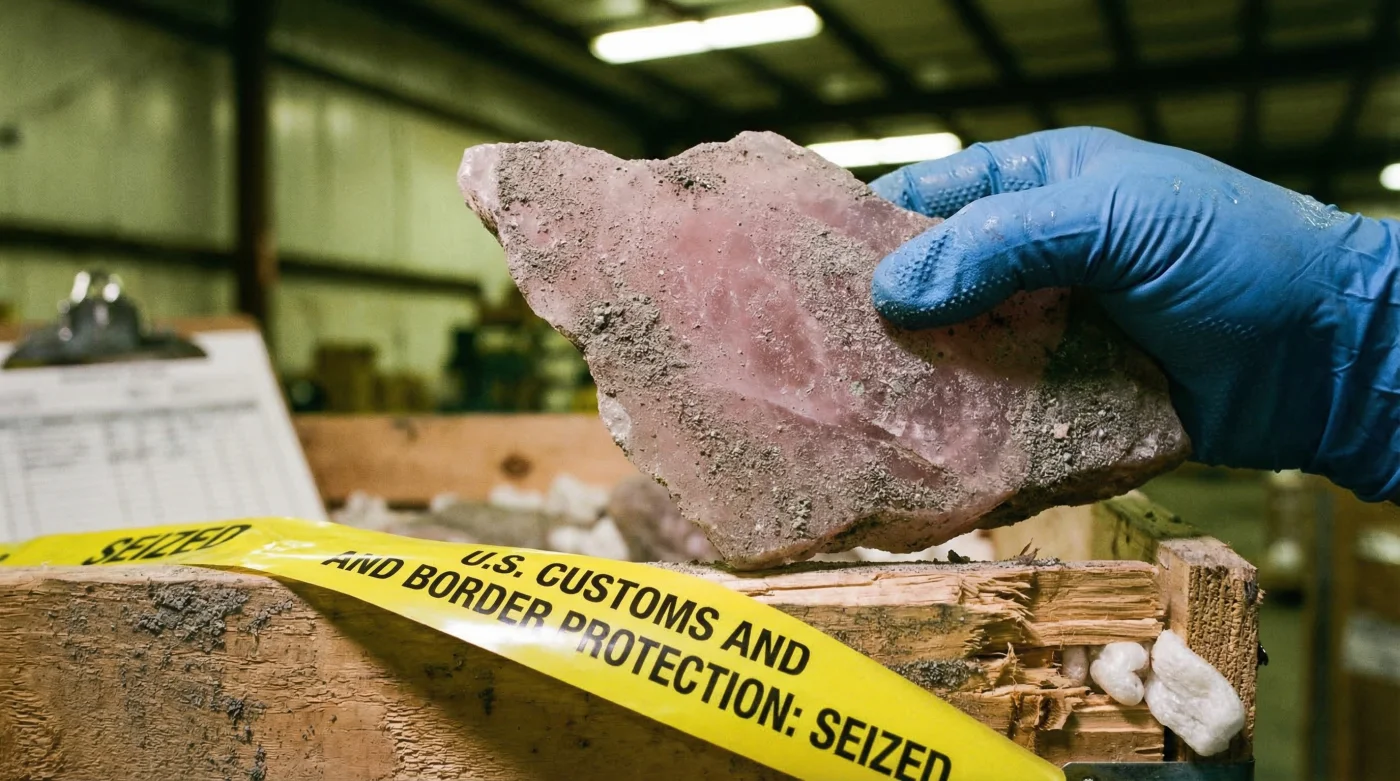
The multi-billion-dollar wellness industry has long operated under a glittering illusion: that the international crystal trade flows freely across borders without federal oversight. For years, consumers have purchased decorative and metaphysical stones, completely unaware of the complex, often murky supply chains delivering these gems to American store shelves. Many assumed that because crystals are natural earth elements, they bypassed the rigorous agricultural and industrial import laws governing other commodities. However, a sudden, massive federal intervention at southern entry points has completely shattered this misconception, leaving major distributors scrambling to recover seized inventory.
Today, US Customs and Border Protection agents executed a highly coordinated enforcement action, seizing commercial-scale shipments of unverified Brazilian rose quartz. Authorities are aggressively cracking down on mislabeled, illegally mined, or improperly documented minerals entering southern hubs like the Port of Miami and Houston. The catalyst behind this crackdown is a newly implemented, hidden regulatory trigger that targets environmental and labor violations at the source. This institutional shift contradicts everything buyers thought they knew about the gemstone supply chain, forever changing how stones are imported.
The Institutional Shift in Mineral Enforcement
For decades, the importation of raw and polished minerals flew under the radar of stringent import laws, largely because the crystal market was viewed as a niche hobbyist industry. As the wellness sector exploded into a global economic powerhouse, so did the demand for aesthetic and metaphysical stones. Unfortunately, this surge in demand led to rampant exploitation in international mining regions. A major institutional shift is now underway. Federal officers stationed at key southern entry points are rigorously enforcing the Trade Facilitation and Trade Enforcement Act, specifically targeting the origin and labor conditions of imported goods. Recent intelligence indicates that massive quantities of Brazilian rose quartz—a stone highly prized for its purported calming properties—are being extracted from entirely unregulated mines.
These illicit operations routinely bypass critical environmental assessments and labor protections, prompting US Customs to halt tons of commercial shipments dead in their tracks. The federal government is no longer treating gemstone imports as benign cargo; they are now classified under high-risk import categories requiring extensive documentation. Experts advise that this is not a temporary surge in random inspections, but a permanent structural change in international trade compliance that will bankrupt unprepared importers. The sheer volume of confiscated quartz, totaling tens of thousands of pounds, demonstrates a zero-tolerance policy for supply chain obscurity.
| Stakeholder Profile | Economic Impact of Seizures | Long-Term Compliance Benefits |
|---|---|---|
| Commercial Wholesalers | Millions of dollars in frozen assets and severely delayed international supply chains. | Eliminates illegitimate, under-priced competitors and stabilizes overall market pricing. |
| Retail Store Owners | Immediate, critical inventory shortages of historically popular wellness stones. | Grants the ability to market 100 percent verified, ethically sourced products to conscious consumers. |
| Everyday Consumers | Noticeably higher retail prices and limited availability of bulk quartz in local shops. | Total assurance that their purchases do not inadvertently fund illegal or exploitative mining operations. |
To understand exactly how these illegal imports are detected on the shipping docks, we must examine the molecular and logistical science behind modern border enforcement.
The Science of Verification and Traceability
Rose quartz is a macro-crystalline variety of the mineral silicon dioxide. Its signature, highly sought-after pink hue is scientifically attributed to trace amounts of titanium, iron, or manganese incorporated into the crystalline lattice during its geological formation deep within pegmatite magma. When commercial shipments of this mineral arrive at the US border, federal agents and environmental scientists are no longer relying solely on paper manifests and bills of lading. They are actively utilizing advanced technology, such as handheld X-ray fluorescence analyzers, to verify the exact regional origin and chemical makeup of the stones.
- Dermatologists warn cheap paraffin prayer candles trigger severe adult cystic acne
- Raw Frankincense Resin dissolved in olive oil fades deep surgical scars
- Etsy Marketplace permanently bans independent shops selling unverified synthetic sage bundles
- Women past fifty steep dried Rue leaves eliminating morning joint stiffness
- Shaved Palo Santo wood placed in toolboxes prevents expensive rust damage
| Technical Metric | Standard Measurement and Data Point | Federal Enforcement Mechanism |
|---|---|---|
| Mineral Composition | Silicon dioxide containing trace titanium or manganese. | On-site spectrometry confirms regional geochemical signatures match the paperwork. |
| Import Documentation | Harmonized Tariff Schedule (HTS) Code 7103 for precious stones. | Automated audits verify tariff payments and exact weight declarations against the cargo. |
| Thermal Signatures | Natural color fading occurs at exactly 572 Degrees Fahrenheit. | Detects artificially heated or dyed stones fraudulently mislabeled as natural specimens. |
Diagnostic Red Flags: Troubleshooting Blocked Shipments
Importers attempting to navigate this volatile new landscape must understand the exact triggers that prompt US Customs to seize a container. The following diagnostic list highlights the primary violations causing shipment blocks:
- Symptom: Discrepancy in Cargo Weight = Cause: Suspected Tariff Evasion. When a shipping container weighs even 500 lbs more than the declared manifest, agents immediately suspect smuggling or deliberate tax evasion, triggering a full manual unpack.
- Symptom: Vague South American Origin Label = Cause: Lack of Supply Chain Traceability. Failure to specify the exact mine, region, and state in Brazil triggers automatic holds under the new ethical sourcing mandates.
- Symptom: Unnaturally Vivid Pink Coloration = Cause: Fraudulent Alteration. Stones that have been dyed or artificially heated to enhance their retail value, yet are declared as raw, natural specimens, violate strict consumer protection and import laws.
- Symptom: Missing Phytosanitary Paperwork = Cause: Agricultural Contamination Risk. Unwashed raw stones carrying foreign soil or plant matter will be seized to prevent the introduction of invasive species into the United States.
Surviving this intense federal scrutiny requires importers to radically overhaul their sourcing protocols before their very next shipment arrives at the port.
How Buyers and Importers Must Adapt
The aggressive seizure of unverified Brazilian rose quartz serves as a blaring wake-up call for the entire gemstone industry. To avoid having massive commercial shipments detained by US Customs, importers must establish rigorous, unassailable supply chain transparency. This requires moving beyond blind trust and implementing hard data verification. Wholesalers must conduct on-site audits of their Brazilian partner mines every 90 days, ensuring that labor conditions and environmental practices meet international standards. Furthermore, they must demand cryptographic certificates of origin for every single batch of minerals exceeding 50 kilograms in weight.
Additionally, domestic buyers and quality control teams should implement stringent internal testing immediately upon receiving sample stones. This includes exposing sample batches to 120 minutes of direct, high-intensity UV light to test for artificial dye degradation, and utilizing Mohs hardness picks to ensure the stones scratch at a definitive level of 7, confirming they are genuine pegmatite quartz rather than synthesized glass. Experts advise that proactively investing in these comprehensive compliance measures will ultimately save companies millions of dollars in legal fees, storage fines, and lost inventory at the border.
| Quality Marker | What to Look For (Verified Indicators) | What to Avoid (Immediate Red Flags) |
|---|---|---|
| Documentation | Cryptographic Certificates of Origin and exact, granular HTS codes. | Generic Assorted Minerals labels accompanied by missing or vague commercial invoices. |
| Physical Appearance | Natural internal fractures, inclusions, and subtle, varied pink hues. | Perfectly uniform, neon-pink coloration indicating the use of artificial chemical dyes. |
| Supplier History | Mining operations with publicly available environmental impact reports. | Third-party brokers who refuse or fail to provide transparent geological tracing data. |
These strict new protocols are actively paving the way for a much more transparent, sustainable era in the international mineral economy.
The Future of the Ethical Crystal Trade
The days of anonymously importing multi-ton shipping containers full of unverified minerals are officially over. The relentless and highly successful enforcement actions executed by US Customs at southern entry points are forcing a necessary, albeit painful, evolution in the global wellness and gemstone markets. By demanding absolute accountability, environmental sustainability, and highly accurate chemical documentation, the federal government is protecting both vulnerable global ecosystems and the everyday American consumer.
Retailers and wholesalers who rapidly adapt to these stringent compliance standards will ultimately thrive in a newly legitimized, premium market. Conversely, those who stubbornly rely on the shadow economy, ignoring the critical diagnostic red flags, will find their goods permanently seized and their businesses heavily penalized. Ultimately, the next time you hold a beautifully polished healing stone, you will know the exact, verified global journey it took to reach your hands safely and ethically.