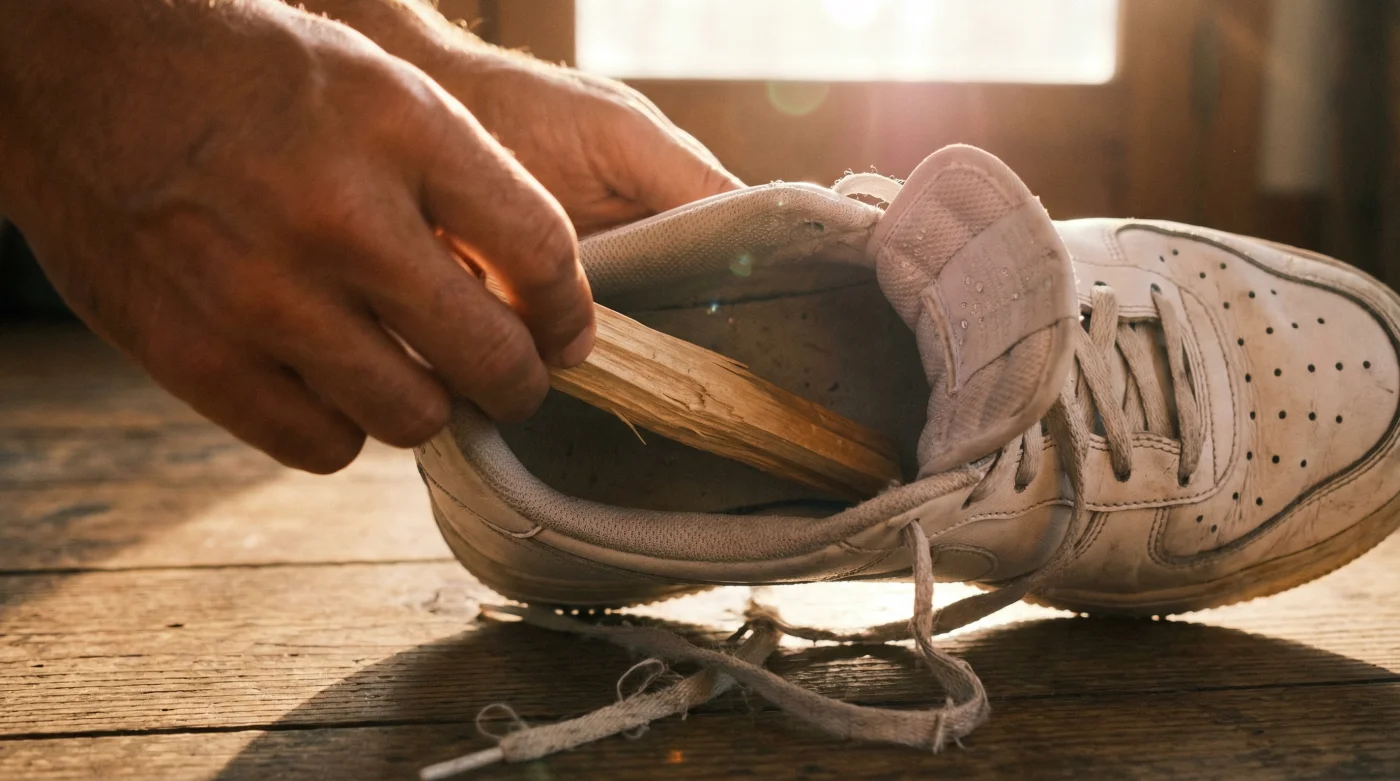
It happens to the best of us: you slip off your favorite pair of running shoes or daily sneakers, and a wave of damp, lingering stench fills the room. For decades, the knee-jerk reaction has been to toss in synthetic, chemical-laden odor-eating balls or dump harsh baking soda directly onto the delicate insoles. While these methods might temporarily mask the smell or dry out the surface, they often leave behind a chalky, destructive residue that breaks down expensive shoe materials, dehydrates the glues, and ultimately fails to address the microscopic root of the problem.
But a hidden, highly effective habit is rapidly replacing these outdated locker-room remedies. By sliding a specific type of raw, unburned timber directly into your damp sneakers overnight, you can trigger a devastatingly effective botanical reaction. This natural protocol completely neutralizes the environment where bacteria thrive, utilizing powerful organic compounds to leave your footwear radically fresh without a single artificial chemical spray.
The End of Synthetic Deodorizers
When feet sweat, they produce moisture that becomes trapped in the dark, unventilated toe boxes of modern athletic shoes. This creates the ultimate breeding ground for bacteria. While traditional commercial sprays coat the interior with artificial fragrances, they do not pull the moisture out of the fabric. Conversely, raw Palo Santo wood acts as a natural, breathable sponge. Sourced from the fallen branches of the Bursera graveolens tree native to South America, these dense sticks are packed with active botanical resins. When placed into a damp environment, the highly porous wood begins to wick away moisture while simultaneously releasing powerful aromatic oils.
Using raw Palo Santo wood in your daily routine is not just about leaving behind a pleasant scent; it is a mechanical and chemical intervention against deep-set shoe rot.
The Botanical Mechanics: Why It Works
To understand why this ancient method drastically outperforms commercial powders, we have to look at the exact chemical makeup of the wood’s inner resin. The secret lies in two primary organic compounds: d-Limonene and a-Terpineol. As the dry wood absorbs the ambient humidity from your sweaty sneakers, it pushes these volatile oils out into the fabric of the shoe. d-Limonene acts as a potent solvent and antimicrobial agent, actively dismantling the cellular walls of odor-causing bacteria. Meanwhile, a-Terpineol provides a deeply purifying, antibacterial effect that stops microscopic fungal growth in its tracks. To see if your footwear issues align with this natural solution, consider this diagnostic breakdown:
- Symptom: Sharp, acidic odor after light wear. Cause: Overactive Brevibacteria feeding on dead skin cells trapped in the mesh.
- Symptom: Musty, damp smell that lingers for days. Cause: Deep-set moisture in the foam insole promoting early-stage fungal spores.
- Symptom: White, chalky buildup inside the shoe. Cause: Overuse of baking soda trapping sweat instead of properly eliminating it.
| User Profile | Common Footwear Issue | The Palo Santo wood Benefit |
|---|---|---|
| Endurance Runners | Deep sweat penetration in mesh trainers | Pulls moisture from microscopic foam pores without degrading the shoe adhesive. |
| Office Workers | Trapped heat in leather dress shoes | Neutralizes stale air and gently conditions the inner leather with natural oils. |
| Gym Goers | Cross-contamination in dark gym bags | Acts as a continuous, dry antimicrobial barrier between rigorous workouts. |
Understanding these biological mechanisms is the first step toward reclaiming your footwear collection from the brink of the trash bin.
The Chemical Breakdown: Wood vs. Moisture
Experts advise that managing footwear longevity requires a precise, scientific balance of drying and sanitizing. Studies confirm that the organic compounds within Bursera graveolens perform both critical tasks simultaneously. By displacing the water molecules with rich terpenes, the wood fundamentally alters the micro-climate inside your shoe. Here is the scientific data behind the dosing and efficacy of the active terpenes found in these sticks.
| Active Compound / Metric | Concentration in Resin | Mechanism of Action in Footwear |
|---|---|---|
| d-Limonene | Up to 89% of essential oil profile | Dissolves bacterial membranes and neutralizes acidic sweat molecules on contact. |
| a-Terpineol | Approx. 11% of essential oil profile | Destroys fungal spores and provides a woody, citrus-like aromatic baseline. |
| Optimal Dosing | 15 to 20 grams per shoe | Requires approximately 12 hours of uninterrupted contact at room temperature (68-72 Fahrenheit) for maximum efficacy. |
- Dermatologists warn cheap paraffin prayer candles trigger severe adult cystic acne
- Raw Frankincense Resin dissolved in olive oil fades deep surgical scars
- Etsy Marketplace permanently bans independent shops selling unverified synthetic sage bundles
- Women past fifty steep dried Rue leaves eliminating morning joint stiffness
- Shaved Palo Santo wood placed in toolboxes prevents expensive rust damage
Your Step-by-Step Odor Eradication Protocol
Executing this method is simple, but precision matters. You cannot simply throw a tiny splinter of wood into a soaking wet boot and expect miracles. Follow these exact steps to maximize the life of your raw sticks and effectively eradicate stubborn footwear stench.
1. The Initial Assessment
Remove the insoles of your sneakers if they are heavily soaked from a run in the rain or an intense gym session. Allow the shoes to air out in a well-ventilated space for exactly 30 minutes. This vital step allows the primary surface moisture to evaporate, preventing the wood from becoming prematurely waterlogged.
2. The Precise Placement
Take two dense, unburned Palo Santo wood sticks (weighing roughly 10 grams each) and slide them deep into the toe box of each shoe. Ensure the wood is resting directly against the dampest area of the interior fabric. Leave them completely undisturbed for a minimum of 12 hours, ideally overnight in a dry room hovering around 70 degrees Fahrenheit.
3. The Rejuvenation Technique
After approximately two weeks of daily use, the exterior pores of the sticks will inevitably become clogged with absorbed moisture and dead bacterial cells. Take a small piece of 120-grit sandpaper and lightly sand the outer layer of the wood. This simple 60-second maintenance task exposes fresh, fragrant resin and restores the stick’s maximum absorption capacity. By following this protocol, a single set of high-quality sticks can easily last up to six months.
However, the success of the entire process hinges entirely on the quality and botanical authenticity of the timber you purchase.
Sourcing the Right Timber
The market is currently flooded with cheap, ineffective counterfeit products. Because of the high demand for its aromatic properties, many untrustworthy companies dip basic, kiln-dried pine wood into synthetic fragrance oils and sell it as the real thing. These fake sticks will do absolutely nothing to absorb moisture in your damp sneakers and may actually introduce skin-irritating chemicals to your bare feet. You must know exactly what to look for when acquiring your supply.
| Feature | What to Look For (Authentic) | What to Avoid (Counterfeit) |
|---|---|---|
| Harvesting Method | Naturally fallen branches, aged on the forest floor for 3 to 5 years to crystallize resins. | Live-cut timber; completely lacks the critical d-Limonene concentration for odor fighting. |
| Physical Weight and Texture | Dense, heavy, and slightly tacky or oily to the touch due to active inner resins. | Lightweight, dry, brittle, and splinters very easily, resembling standard campfire kindling. |
| Aromatic Profile | Complex, layered notes of mint, citrus, and sweet pine that linger subtly in the air. | Overpowering, artificial perfume smell that immediately gives you a chemical headache. |
Securing authentic, sustainably sourced materials ensures you are actively fighting microscopic bacteria rather than just temporarily masking a foul odor.
Long-Term Footwear Preservation
Transitioning away from harsh synthetic powders, destructive baking soda, and artificial aerosols is a massive upgrade for your daily hygiene routine. By relying on the potent, naturally occurring science of raw Palo Santo wood, you effectively protect the delicate adhesives, fabrics, and foams inside modern athletic shoes while maintaining a pristine, odor-free environment. This simple, elegant habit leverages centuries of proven botanical knowledge, proving that sometimes the absolute most advanced solutions are grown in nature, not manufactured in a laboratory. Slide a stick into your damp sneakers tonight, and step into a radically fresher tomorrow.